नमस्ते दोस्तों!
स्वागत है The Easy Master पर!
आपने security concepts toh seekh liye – Shift Left Security, DevSecOps, secure coding practices। Lekin ab एक सवाल – “Web application mein sabse common vulnerabilities kaun si hain? Hackers kis tarah attack karte hain? Aur unse kaise bachna hai?”
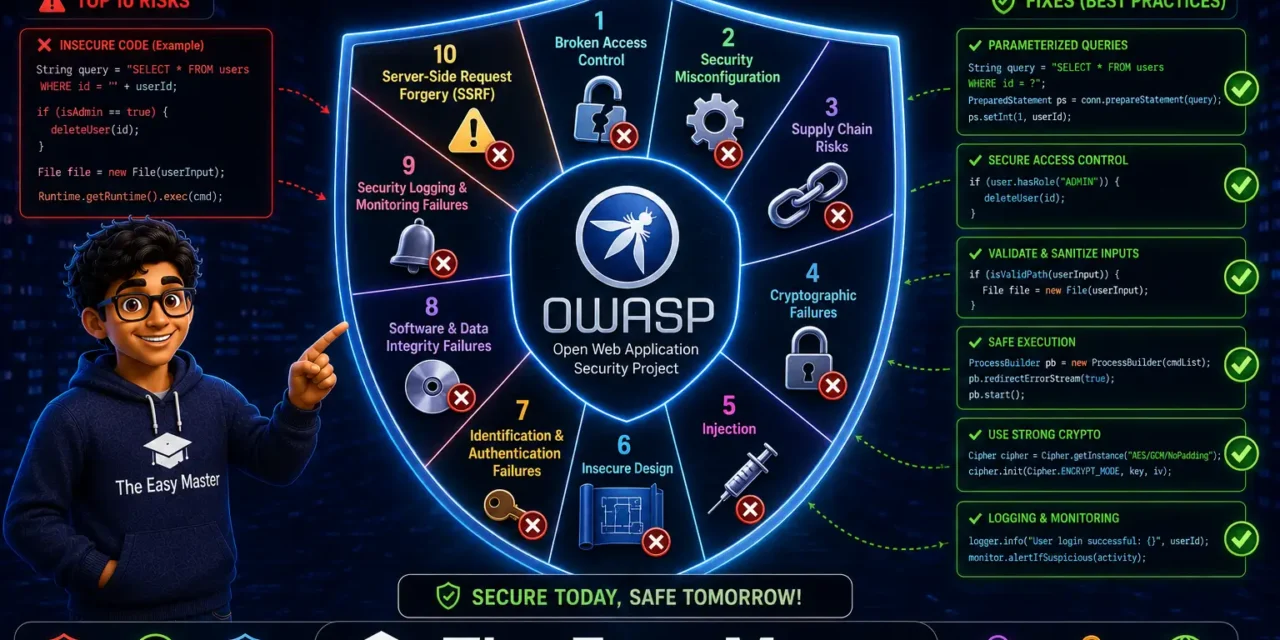
Yahi sawaal hai jo har developer, security engineer, aur architect ke dimaag mein aata hai। Aur iska jawab hai OWASP Top 10 – ek globally recognized list of most critical web application security risks।
Jab maine pehli baar OWASP Top 10 padha, toh mujhe laga ki ye ek standard checklist hai jo har developer ko follow karna chahiye। Lekin reality mein iska importance usसे भी zyada है – OWASP Top 10 web security ka “constitution” है। OWASP ek nonprofit foundation hai jo 2001 mein astitva mein aaya, aur aaj tak ye document web application security ka global standard bana hua है। 175,000 से zyada CVE records aur 589 Common Weakness Enumerations (CWEs) ke analysis ke baad ye list tayar ki gayi है।
इस OWASP Top 10 in Hindi article mein main aapko sikhata hoon:
✅ OWASP kya hai and kyun important hai – history, purpose
✅ Top 10 vulnerabilities in detail – description, real examples, fixes
✅ Practical code examples – vulnerable vs secure code (Node.js, Python)
✅ Latest updates (2025/2026) – new categories, ranking changes
✅ AI-related risks – “Vibe Coding” aur LLM security
✅ Common mistakes – aur unka solution
Chaliye OWASP Top 10 ko detail mein samajhte hain aur apni apps ko secure banana seekhte hain! 🛡️🚀
Table of Contents
1. OWASP Kya Hai? – Introduction and Importance
OWASP (Open Worldwide Application Security Project) ek nonprofit foundation hai jo web application security ko improve karne ke liye kaam karta hai। Unka sabse famous contribution है OWASP Top 10 – web applications ke 10 most critical security risks ki list।
OWASP Top 10 2003 mein pehli baar release hui thi। Tab se lekar ab tak ye document evolution kar raha hai, reflecting how quickly modern application threats are evolving – especially with AI-heavy and highly distributed architectures। 2025 version 8th installment है और ye 2021 ke baad pehla major update है।
Kyun important hai OWASP Top 10?
OWASP ka kaam: OWASP community-driven organization है – data contribute karne wale organizations, security experts, and developers milkar is list ko update karte hain।
2. 2025/2026 Updates – क्या बदला है?
OWASP Top 10 2025/2026 mein do naye categories aaye hain and ranking mein significant shifts hain:
| Rank | 2021 Category | 2025/2026 Category | Change |
|---|---|---|---|
| A01 | Broken Access Control | Broken Access Control | ➡️ No change (includes SSRF now) |
| A02 | Cryptographic Failures | Security Misconfiguration | 🔼 Up from #5 |
| A03 | Injection | Software Supply Chain Failures | 🆕 New (expanded from Vulnerable Components) |
| A04 | Insecure Design | Cryptographic Failures | 🔽 Down from #2 |
| A05 | Security Misconfiguration | Injection | 🔽 Down from #3 |
| A06 | Vulnerable & Outdated Components | Insecure Design | 🔽 Down from #4 |
| A07 | Identification & Auth Failures | Authentication Failures | ➡️ Similar |
| A08 | Software & Data Integrity Failures | Software & Data Integrity Failures | ➡️ No change |
| A09 | Security Logging & Monitoring Failures | Logging & Alerting Failures | ➡️ No change |
| A10 | Server-Side Request Forgery (SSRF) | Mishandling of Exceptional Conditions | 🆕 New |
Key changes explained:
- Security Misconfiguration #2 पर पहुंचा – क्योंकि software engineering continuously configurations पर dependent होता जा रहा है। Affected 3.00% of applications।
- Supply Chain Failures नया category है – expanded from “Vulnerable & Outdated Components” to include entire software dependency ecosystem, build systems, and distribution infrastructure。
- Injection #5 पर आ गया – SQL injection, XSS jaise vulnerabilities kam ho rahi hain due to better security awareness and modern frameworks।
- SSRF ab Broken Access Control mein merge ho gaya।
- Mishandling of Exceptional Conditions – completely new category for improper error handling, logical errors, and “failing open” scenarios。
3. A01: Broken Access Control – सबसे बड़ा Risk
Broken Access Control tab hota hai jab application authenticated users par proper restrictions enforce nahi karti – attackers unauthorized functionality ya data access kar sakte hain।
Kyun top par hai? For two consecutive releases, OWASP has identified Broken Access Control as the top security risk। “Everyone tries to craft their own authentication and access control mechanisms” – but most people don’t test access control properly। A typical web application may have a hundred endpoints, each one accessible by multiple roles – testing all combinations is very difficult।
Real example:
- User A modifies URL from
/api/orders/123to/api/orders/124and sees another user’s order - Normal user escalates to admin by manipulating a parameter
- Attacker accesses
/api/admin/userswithout proper permission
Common CWEs (40 CWEs in this category):
- CWE-285: Improper Authorization
- CWE-639: Authorization Bypass Through User-Controlled Key (IDOR)
- CWE-862: Missing Authorization
💻 Vulnerable Code (Node.js) – ❌:
app.get('/api/users/:id', async (req, res) => {
  const user = await db.users.findById(req.params.id);
  res.json(user); // No authorization check!
});
✅ Secure Code – Enforce ownership:
app.get('/api/users/:id', authRequired, async (req, res) => {
  // Check user can only access their own data
  if (req.params.id !== req.user.id && req.user.role !== 'admin') {
    return res.status(403).json({ error: 'Forbidden' });
  }
  const user = await db.users.findById(req.params.id);
  res.json(user);
});
How to fix:
- Use Row Level Security (RLS) in databases (PostgreSQL)
- Implement middleware pattern for consistent access control
- Use standard authorization frameworks instead of building custom from scratch
- Test every endpoint with multiple roles
- Use attribute-based access control (ABAC) for complex permissions
- Enforce least privilege principle
4. A02: Security Misconfiguration – Settings Ki Problem
Security Misconfiguration tab hota hai jab security settings properly defined, implemented, ya maintained nahi hote।
- Default credentials never changed (admin/admin)
- Unnecessary features left enabled (debug endpoints, directory listing)
- Verbose error messages revealing sensitive information (stack traces)
- Cloud storage misconfigured (publicly accessible S3 buckets)
- Missing or improper CORS policies
Why has it moved to #2? “Software engineering is continuing to increase the amount of an application’s behavior that is based on configurations” – more configs = more misconfigs。
How to fix:
- Automate configuration scanning – tools like Trivy, Checkov, Snyk IaC
- Use Infrastructure as Code – version-controlled, reviewed configs
- Disable unnecessary features in production
- Implement secure defaults – “secure by default, not by configuration”
- Regularly review and rotate credentials
- Use secrets management (Vault, AWS Secrets Manager) – never hardcode
5. A03: Software Supply Chain Failures – Naya Category
Software Supply Chain Failures – vulnerabilities arising from compromised libraries, poisoned models, insecure infrastructure-as-code templates, build systems, and distribution infrastructure।
This is an expansion of “Vulnerable and Outdated Components” from 2021 to include broader compromises across the entire ecosystem of software dependencies, build systems, and distribution infrastructure。
Why is this a major risk? Modern applications rely heavily on third-party dependencies, CI/CD pipelines, and AI components – dramatically expanding the attack surface beyond your own code। A single compromised dependency can bring down an entire system।
Example attacks:
- Log4j vulnerability (2021) – compromised library affected millions of apps
- SolarWinds supply chain attack
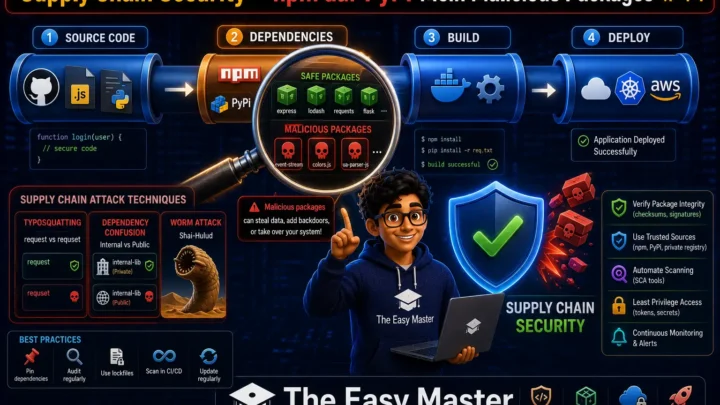
- Typosquatting – attackers publish malicious packages with similar names
How to fix:
- Generate and maintain SBOM (Software Bill of Materials) – know every dependency
- Run SCA (Software Composition Analysis) – Trivy, Snyk, OWASP Dependency-Check
- Use dependency pinning – lock versions, avoid
*or^ranges - Automated dependency updates with security scanning (Dependabot, Renovate)
- Verify package integrity – use package signatures (npm, PyPI)
- Use trusted registries – private registries for internal packages
6. A04: Cryptographic Failures – Encryption की गलतियाँ
Cryptographic Failures – weak cryptographic practices that fail to protect sensitive data – poor encryption, insecure key management, weak hashing।
Common mistakes:
- Storing passwords in plain text or using weak hashing (MD5, SHA1)
- Using outdated or weak encryption algorithms (DES, RC4)
- Hardcoding encryption keys in source code
- Not using TLS/HTTPS or using outdated TLS versions
- Not encrypting sensitive data at rest
💻 Vulnerable Code – ❌:
// NEVER use MD5 or SHA1 for passwords!
const hashedPassword = md5(password);
const hashedPassword = crypto.createHash('md5').update(password).digest('hex');
✅ Secure Code – Use bcrypt/Argon2:
const bcrypt = require('bcrypt');
const SALT_ROUNDS = 12; // Higher = slower = more secure

async function hashPassword(password) {
  return await bcrypt.hash(password, SALT_ROUNDS);
}

async function verifyPassword(password, hash) {
  return await bcrypt.compare(password, hash);
}
How to fix:
- Always enforce TLS 1.3+ for data in transit
- Use bcrypt, Argon2, or scrypt for passwords – never MD5, SHA1, or unsalted SHA256
- Store encryption keys securely (KMS, Vault)
- Use AES-256-GCM for symmetric encryption (authenticated encryption)
- Regularly review and rotate keys
- Never hardcode secrets – use environment variables or secrets managers
7. A05: Injection – SQL, NoSQL, and Command Injection
Injection tab hota hai jab untrusted data को command ya query के part के रूप में interpreter को bheja जाता है – leading to unintended execution।
Includes SQL Injection, NoSQL Injection, Command Injection, and Cross-Site Scripting (XSS)।
💻 Vulnerable Code – SQL Injection – ❌:
// NEVER do this!
const query = `SELECT * FROM users WHERE email = '${userEmail}'`;
const user = await db.query(query);
// Attacker input: ' OR '1'='1' --
// Query becomes: SELECT * FROM users WHERE email = '' OR '1'='1' --'
✅ Secure Code – Use Parameterized Queries:
// Always use parameterized queries
const query = 'SELECT * FROM users WHERE email = $1';
const user = await db.query(query, [userEmail]);
How to fix:
- Always use parameterized queries / prepared statements
- Use ORM frameworks – they usually handle escaping automatically
- Validate and sanitize all user input – allowlist approach
- Use stored procedures where appropriate
- Apply principle of least privilege – database user should have minimal permissions
8. A06: Insecure Design – Design-Level Flaws
Insecure Design – vulnerabilities related to design flaws rather than implementation flaws। A design is insecure if it is vulnerable even when implemented as specified।
Examples:
- Not considering security during architecture design
- Missing threat modeling
- Assuming “we’ll add security later”
- Ignoring security requirements during planning
How to fix:
- Conduct threat modeling during design phase (STRIDE, PASTA)
- Define security requirements early in the SDLC
- Involve security experts in architecture review
- Follow secure design principles: least privilege, defense in depth, zero trust
- Use established security patterns – don’t reinvent the wheel
9. A07: Authentication Failures – Login Ki Problems
Authentication Failures – weak or broken authentication mechanisms allow attackers to compromise user accounts。
Common issues:
- Weak passwords allowed
- No rate limiting on login attempts (brute force)
- Insecure session management (session tokens predictable, not invalidated)
- Credential stuffing attacks
- No multi-factor authentication (MFA)
How to fix:
- Enforce strong password policies – length, complexity, breached password checks
- Implement rate limiting on login endpoints
- Use secure session management – HttpOnly, Secure, SameSite cookies
- Implement MFA – especially for sensitive operations
- Use standard authentication frameworks – OAuth2, OIDC, Passport.js
- Invalidate sessions on logout and password change
10. A08: Software & Data Integrity Failures – Updates and CI/CD
Software & Data Integrity Failures – failures in ensuring the integrity of software updates, CI/CD pipelines, and data。
Examples:
- Insecure CI/CD pipelines (unauthorized access, code injection)
- Unsigned software updates (attacker can inject malicious code)
- Insecure deserialization
- Not verifying integrity of downloaded dependencies
How to fix:
- Sign software artifacts – use code signing
- Secure CI/CD pipelines – restrict access, audit logs
- Use trusted registries for dependencies
- Implement integrity checks – checksums, signatures
- Use immutable infrastructure for builds
11. A09: Logging & Alerting Failures – Visibility Ki Kami
Logging & Alerting Failures – when security events are not logged, monitored, or alerted properly।
Examples:
- No logging of security events (failed logins, access violations)
- Logs not monitored or reviewed
- No alerts for suspicious activity
- Logs not protected (attacker can delete traces)
How to fix:
- Log all security-relevant events – authentication, authorization, input validation failures
- Implement centralized logging – ELK stack, Splunk, Datadog
- Set up alerts for critical events (multiple failed logins, privilege escalation attempts)
- Protect logs from tampering – write-once storage, audit trails
- Regularly review logs – proactive threat hunting
12. A10: Mishandling of Exceptional Conditions – Error Handling
Mishandling of Exceptional Conditions – improper error handling, logical errors, and “failing open” scenarios that systems encounter under abnormal conditions।
New category in 2025/2026 – addresses situations where systems fail insecurely when unexpected conditions occur。
Examples:
- Verbose error messages exposing sensitive information (stack traces, database errors)
- System “failing open” – when something goes wrong, it grants more access instead of less
- Not handling edge cases properly – leading to logical bypass
- Unhandled exceptions causing application crash (DoS)
How to fix:
- Use generic error messages for users – “Something went wrong” – no stack traces
- Log detailed errors internally for debugging
- Handle all exceptions gracefully – never crash on unhandled exception
- Fail securely – deny by default, don’t grant access when uncertain
- Test edge cases thoroughly – invalid inputs, unexpected states
13. AI-Related Risks – “Vibe Coding” and LLM Security
Although AI didn’t make the top ten list, it was included in a “next steps” section। The category is titled “X03:2025 – Inappropriate Trust in AI Generated Code (‘Vibe Coding’)”।
What is the risk? Developers are increasingly using AI code generation tools (GitHub Copilot, ChatGPT, etc.) to write code without fully understanding or reviewing it।
Key recommendation: “Developers should read and fully understand AI-generated code before committing it”।
How to mitigate:
- Review all AI-generated code – don’t blindly trust
- Run security tools (SAST, SCA) on AI-generated code
- Understand the code before committing – don’t “vibe code” without review
- Treat AI as assistant, not replacement – developer is still responsible
Also, for LLM applications, OWASP has a separate Top 10 for LLM Applications covering issues like prompt injection, model poisoning, sensitive data leakage。
14. Common Mistakes (aur Unka Solution!)
15. Resources – Cheat Sheet & Practice Prompts
OWASP Top 10 Quick Reference (2025/2026)
| Rank | Category | Key Fix |
|---|---|---|
| A01 | Broken Access Control | Enforce authorization; test every endpoint; use RBAC/ABAC; implement RLS |
| A02 | Security Misconfiguration | Scan configs; disable unused features; use secure defaults |
| A03 | Software Supply Chain Failures | SBOM; dependency scanning (SCA); pin versions |
| A04 | Cryptographic Failures | TLS 1.3+; bcrypt/Argon2; AES-256-GCM; KMS for keys |
| A05 | Injection | Parameterized queries; input validation; ORM; least privilege DB user |
| A06 | Insecure Design | Threat modeling; secure design principles; security requirements |
| A07 | Authentication Failures | MFA; rate limiting; strong password policies; secure session management |
| A08 | Software/Data Integrity | Sign artifacts; secure CI/CD; verify dependencies |
| A09 | Logging & Alerting | Log security events; centralized logging; alerts for suspicious activity |
| A10 | Mishandling of Exceptions | Generic error messages; log internally; fail securely |
Practice Prompts
Beginner:
- Open a simple Node.js/Express app। Find a route that doesn’t check authorization। Fix it by adding middleware that verifies the user owns the resource।
Intermediate:
- Set up GitHub Actions security workflow with Trivy (SCA + SAST) and Gitleaks (secrets detection) for a sample app। Intentionally add a vulnerable dependency and see if the pipeline blocks it।
Advanced:
- Choose one OWASP category (e.g., Broken Access Control) and design a comprehensive mitigation strategy for a microservices app। Include: API gateway authorization, service-to-service mTLS, database RLS, and automated testing।
16. FAQ
Q1: OWASP Top 10 aur OWASP ASVS mein kya antar hai?
OWASP Top 10 – awareness document for most critical risks (10 items)। OWASP ASVS (Application Security Verification Standard) – detailed checklist of hundreds of security controls for verification。
Q2: OWASP Top 10 2025 mein sabse bada change kya hai?
Two new categories: Software Supply Chain Failures (A03) and Mishandling of Exceptional Conditions (A10)। Security Misconfiguration #2 पर चढ़ा, Injection #5 पर गिरा।
Q3: OWASP Top 10 kaise banata hai?
Combination of security data from dozens of organizations (3 million apps tested) and survey of 221 security experts। 175,000+ CVE records analyzed।
Q4: Kya OWASP Top 10 sirf web apps ke liye hai?
Primarily web apps, but OWASP has separate lists for:
- API Security Top 10
- Mobile Top 10
- LLM Top 10 (AI/GenAI)
- OT Top 10 (Operational Technology)
Q5: Broken Access Control top par kyun hai?
Because it’s a logic flaw – SAST tools can’t understand business intent, DAST tools see 200 OK as success। Automated scanners struggle with access control; defense must be designed into architecture।
Q6: AI-related risks OWASP Top 10 mein kyun nahi hain?
Not enough data yet to justify inclusion, but added to “next steps” section as “X03:2025 – Inappropriate Trust in AI Generated Code (‘Vibe Coding’)”।
Q7: Kya OWASP Top 10 follow karne se app 100% secure ho jati hai?
No – but it’s a great starting point। OWASP Top 10 is an awareness document, not a compliance checklist। Combine with ASVS, secure coding practices, and continuous security testing。
17. Conclusion – Ab Aapki Baari!
Bahut badhiya! Aapne aaj seekh liya:
✅ OWASP Top 10 in Hindi – 10 most critical web security risks
✅ 2025/2026 updates – new categories, ranking shifts, AI risks
✅ A01: Broken Access Control – #1 risk, logic flaw, tricky to test
✅ A02: Security Misconfiguration – misconfigs ki problem, now #2
✅ A03: Software Supply Chain Failures – dependencies, CI/CD, SBOM
✅ A04: Cryptographic Failures – bcrypt, TLS 1.3+, AES-256-GCM
✅ A05: Injection – SQL, XSS – parameterized queries are the answer
✅ A06-A10 – design flaws, auth failures, logging, error handling
✅ AI-related risks – “vibe coding” caution, LLM security
✅ Practical code examples – vulnerable vs secure code
✅ Common mistakes and fixes
OWASP Top 10 web security ka foundation है – isko samajhna aur implement karna har developer ki responsibility है। Security ek mindset hai – design se shuru, deployment tak।
Aapki challenge: Apne existing project mein se ek OWASP vulnerability identify करो (use SAST tools like Semgrep या manual review)। Fix it and document the fix। Apna experience comment mein share karo!
Next topic kya chahiye?
- OWASP Top 10 for APIs (API Security)?
- OWASP Top 10 for LLMs (AI Security)?
- Secure Coding Practices – Practical Guide?
Comment mein batao!
The Easy Master ke saath OWASP Top 10 seekhte raho। Happy securing! 🛡️🚀
Resources
- OWASP Top 10 2025 – Official Site
- OWASP Top 10 2025 – GitHub Repository
- OWASP Top 10 for LLM Applications
- OWASP Cheat Sheet Series
- OWASP ASVS (Application Security Verification Standard)
Additional Resources
- FastAPI Kya Hai? FastAPI Python Setup Aur Pehla API Hindi 2026
- FastAPI Path Parameters Hindi – शून्य से हीरो तक गाइड 2026
- Pydantic v2 Tutorial Hindi – Data Validation Master 2026
- FastAPI dependency injection Hindi – Code Reuse Ka Magic
- FastAPI Async Await Hindi – Non-Blocking Code 2026
- FastAPI PostgreSQL SQLModel Hindi – Async Guide 2026
- FastAPI JWT Authentication Hindi – Secure API Login
- FastAPI OpenAI Integration Hindi – AI Chatbot API 2026
- FastAPI Multi-Agent AI Hindi – LangGraph Zero to Hero
- FastAPI Deployment Hindi – Railway Zero to Hero 2026
- Docker Introduction in Hindi? Containers vs Virtual Machines
- Docker Images and Containers Hindi – Pehla Container
- Docker Compose Tutorial Hindi – Node.js + MongoDB
- Docker Volumes Networking Hindi – Data Persist कैसे करें
- Kubernetes Architecture Hindi – Pods, Nodes, Cluster
- Minikube Tutorial Hindi – Local Cluster कैसे बनाए
- Kubernetes Deployments Services Hindi – App Expose Karein
- K8s Ingress Tutorial Hindi – Domain se App Access
- Helm Kya Hai? – Kubernetes Charts Se App Deploy
- GraphQL Introduction in Hindi – REST vs GraphQL Comparison
- GraphQL Schema Tutorial Hindi – Types Queries Resolvers
- GraphQL Queries Mutations Hindi – Frontend Integration
- GraphQL Advanced Features Hindi – Fragments Aliases Variables
- Apollo Server GraphQL Node.js TypeScript Hindi – API Kaise Banaye
- Apollo Client React Hindi – GraphQL Queries Use Kaise Karein
- GraphQL Testing Supertest Hindi – Queries Mutations Test
- Integration Testing Node.js – Mock DB aur APIs Hindi
- E2E Testing Playwright – GraphQL Frontend Testing & CI/CD Hindi
- System Design Kya Hai? System Design Introduction in Hindi
- Vertical Horizontal Scaling Hindi – कब क्या Use करें
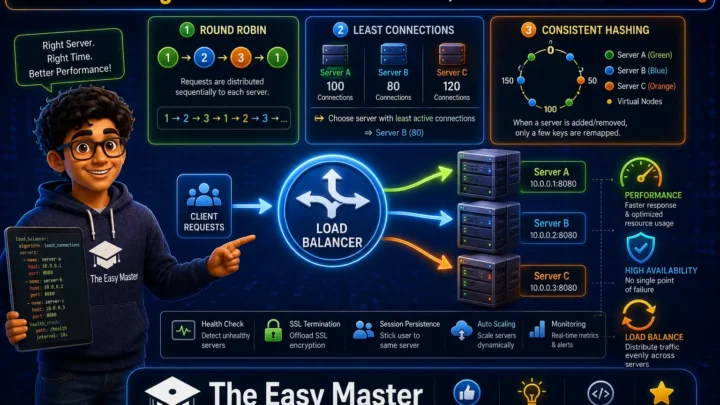
- Load Balancing Tutorial Hindi: Round Robin and Hashing
- Microservices vs Monolith Hindi – Modular Monolith se Safar
- Message Queues (RabbitMQ, Kafka) – EDA Samjhe Hindi
- Consistent Hashing Hindi – Distributed Caching & Sharding
- System Design Case Study Hindi – TinyURL WhatsApp Instagram
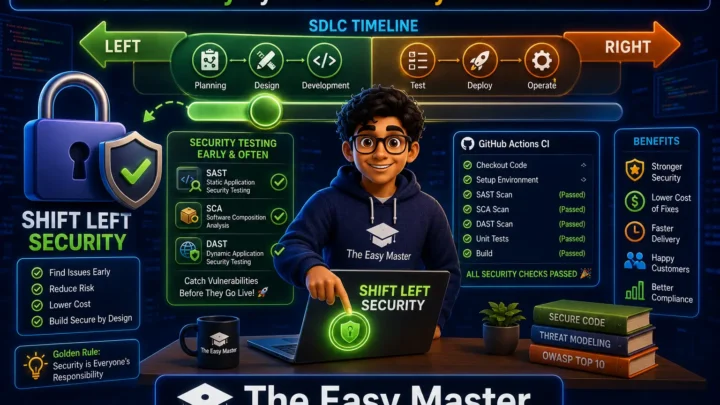
- Shift Left security in Hindi– Security Ko Pehle se कैसे करें