नमस्ते दोस्तों!
स्वागत है The Easy Master पर!
आपने microservices, scaling, load balancing – सब कुछ सीख लिया। अब एक important topic है – Event-Driven Architecture (EDA) और Message Queues.
Kyunki jab aapke microservices एक दूसरे से synchronously (direct HTTP call) baat karte hain, toh tight coupling हो जाती है। Ek service slow hui toh baaki bhi affect hote hain। है न problem?
Jab maine pehli baar ek e-commerce platform banaya, toh order service, payment service, inventory service, sab synchronously communicate kar rahe the। Payment service down hua toh orders fail होने लगे। Tab maine message queues introduce ki – orders ko queue mein daalna, payment service जब ready ho tab process karna। Result? System resilient और decoupled हो गया।
इस Message queue system design Hindi article mein main aapko sikhata hoon:
✅ Event-Driven Architecture kya hai? – Decoupling ka magic
✅ Message Queue vs Event Streaming – RabbitMQ vs Kafka
✅ Core Concepts – Producer, Consumer, Queue, Topic, Partition, Offset
✅ RabbitMQ – Exchange, Binding, Routing Key, DLQ
✅ Apache Kafka – Broker, Topic, Partition, Consumer Group, Offset
✅ Benefits – Loose Coupling, Scalability, Fault Tolerance, Resilience
✅ Delivery Guarantees – At-most-once, At-least-once, Exactly-once
✅ Real-world use cases – E-commerce, Logging, CDC
✅ Common mistakes aur best practices
Chaliye message queues aur event-driven architecture ka safar shuru karte hain! 🚀📨
Table of Contents
1. Event-Driven Architecture Kya Hai? – A New Way to Think
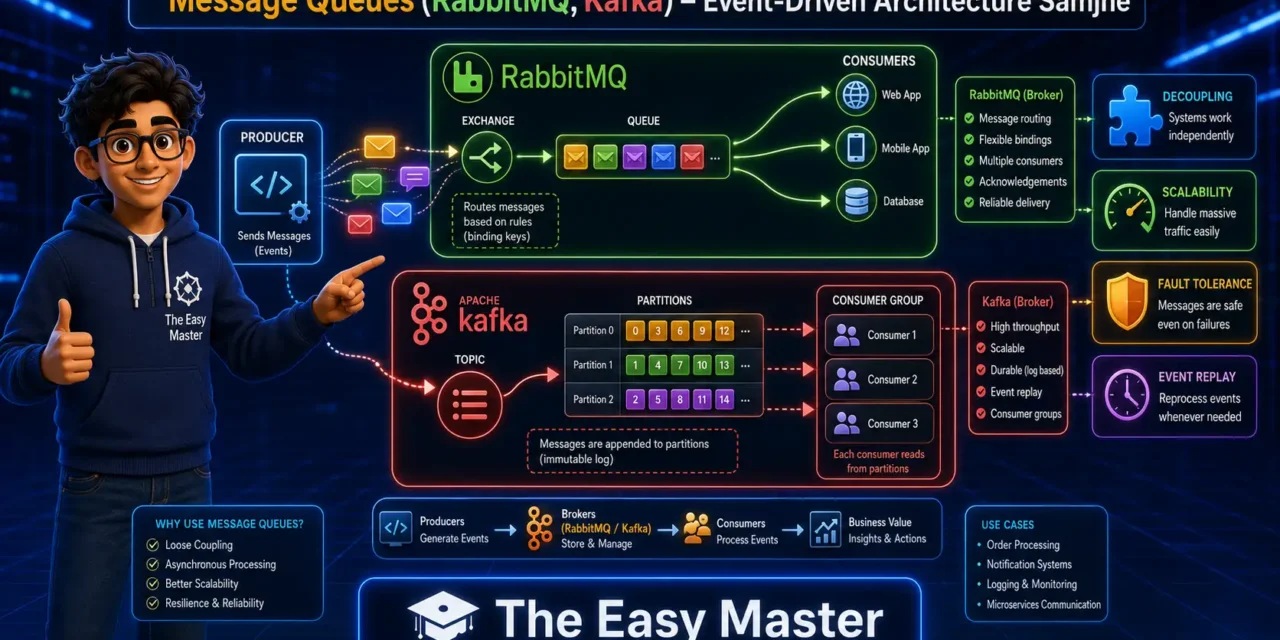
Event-Driven Architecture (EDA) एक architectural pattern है जिसमें components एक दूसरे से directly call nahi karte, बल्कि events (something happened) publish karte hain. Doosre components in events ko subscribe karte hain और react karte hain।
Example:
E-commerce mein Order Placed event publish होता है। Payment Service, Inventory Service, Notification Service – सब इस event को consume karte hain। अगर Inventory Service down है, तो भी order placed हो जाएगा – Inventory Service बाद में process कर लेगी।
Analogy: Event-Driven Architecture एक WhatsApp group जैसा है। Aap message bhejte ho (event publish), aur jo interested hain (subscribers) woh dekhte hain। Aapko nahi pata kaun dekhega aur kaun nahi।
Synchronous (Request-Response) vs Asynchronous (Event-Driven):
| Aspect | Synchronous (HTTP/RPC) | Asynchronous (Message Queue) |
|---|---|---|
| Communication | Direct, blocking | Indirect, non-blocking |
| Coupling | Tight | Loose |
| Failure handling | Cascading failures | Decoupled, retries |
| Scalability | Hard (each service scale together) | Easy (scale independently) |
| Latency | Low (but blocking) | Variable (non-blocking) |
| Use case | Simple CRUD, real-time user actions | Background processing, event propagation |
2. Message Queue vs Event Streaming – RabbitMQ vs Kafka
Most people think Kafka is just a replacement for RabbitMQ. That is true only to some extent. They solve different problems, even though both are often grouped as “messaging systems”.
RabbitMQ answers: “Who should process this message?”
Kafka answers: “What happened, and who might be interested?”
Performance note: If your overall messaging throughput is below 50,000 msg/sec per queue, you can safely use RabbitMQ, which is simpler, faster, more efficient, and easier to get started.
Kafka 4.3 (released June 2026) is the current stable version (May 2026). With 25 KIPs and over 600 commits, Kafka 4.3 introduces new features like follower fetching from tiered offset, broker cordoning, share groups, and more. As of Kafka 4.0 (March 2025), ZooKeeper is gone; Kafka now uses KRaft (Kafka Raft) for consensus. Any setup that still has ZooKeeper is already legacy.
3. Core Concepts – Producer, Consumer, Queue, Topic
Common to both RabbitMQ and Kafka:
| Concept | Definition |
|---|---|
| Producer | वह service/application जो messages/events bhejti है |
| Consumer | वह service/application जो messages/events receive और process karti है |
| Broker | Message queue server (RabbitMQ node या Kafka broker) |
| Message/Event | Data payload जो producer से consumer तक जाता है |
RabbitMQ-specific concepts:
- Queue – FIFO data structure जो messages store karta है
- Exchange – Messages को routing keys के हिसाब से queues में route karta है
- Binding – Exchange और queue के बीच का link, routing key ke saath
- Routing Key – Message attribute जो exchange को बताता है कि message kahan जाना चाहिए
- Dead Letter Exchange (DLX) – Unroutable या failed messages के लिए
Kafka-specific concepts:
- Topic – Events का named stream (like database table, but append-only)
- Partition – Topic की unit of parallelism। Each partition is an ordered, immutable log on disk
- Offset – Unique sequential ID of a message within a partition。 Offset 0 is first message.
- Consumer Group – Set of consumers that split a topic’s partitions between them। Each partition assigned to exactly one consumer per group.
- Broker – A Kafka server that stores messages (broker stores messages, serves producers/consumers).
- Producer – Writes events to topics。
- Consumer – Reads events from topics, tracks position via committed offset。
4. RabbitMQ – Message Broker Samjhein
RabbitMQ is the most widely deployed, cross-platform, lightweight open source message broker that implements AMQP (Advanced Message Queuing Protocol).
Basic Workflow:
Producer → Exchange → (Binding) → Queue → Consumer4.1 Exchange Types
| Exchange Type | Routing Logic | Use Case |
|---|---|---|
| Direct | Routing key exact match | Point-to-point, task distribution |
| Fanout | Broadcast to all bound queues | Pub-sub, notifications |
| Topic | Wildcard pattern match (*.order.*) | Complex routing, event types |
| Headers | Header attributes match | Advanced filtering |
4.2 Message Acknowledgment (ACK)
Consumer message process karne ke baad acknowledgment bhejta hai। Agar consumer बिना ack किए disconnect होता है, RabbitMQ message दूसरे consumer को भेज देता है।
4.3 Message Durability
Queues aur messages को durable mark kiya जा सकता है – broker restart होने पर भी messages survive karte hain।
4.4 Prefetch Count
Controls how many messages consumer एक साथ ले सकता है – prevents consumer overload.
4.5 RabbitMQ in 2026
RabbitMQ continues to be a legit alternative for high-throughput use cases. Its streams feature offers an alternative to Kafka, with the added benefit of RabbitMQ’s flexibility. RabbitMQ is simple, fast, and efficient.
5. Kafka – Event Streaming Platform Samjhein
Kafka is a distributed event streaming platform. The core abstraction is a log: an ordered, append-only sequence of records.
5.1 Partitions – Unit of Parallelism
- Topic divided into partitions (each partition ordered independently)
- Ordering guarantee: Within a partition, strict ordering। Across partitions, no ordering.
- Partition count rule of thumb:
partitions = max(target throughput / single-partition throughput, number of consumers). Start conservative; you can increase partition count later, but you can never decrease it.
5.2 Offsets and Consumer Groups
Consumers track their position by committing the last offset they processed – allows resuming after restart without reprocessing or missing messages.
Consumer group: Consumers split partitions between them. Each partition assigned to exactly one consumer in the group at a time. To process faster, add consumers to the group – up to number of partitions. Beyond that, extra consumers sit idle.
5.3 Kafka KRaft (No ZooKeeper)
As of Kafka 4.0 (released March 2025), ZooKeeper is gone. The architecture changed, the config changed. Any setup that still has ZooKeeper is already legacy. KRaft (Kafka Raft) is the new consensus protocol。
5.4 Kafka Use Cases for Data Engineers
- Real-time ingestion: Data arrives faster than batch pipeline can process – Kafka buffers reliably。
- Decoupling producers from consumers: Add new downstream systems without changing anything about the producer。
- Change Data Capture (CDC): Kafka Connect + Debezium streams database changes (insert/update/delete) to Kafka topics。
5.5 Kafka 4.3 (June 2026) – What’s New
Kafka 4.3.0 was released in May/June 2026 with 25 KIPs and over 600 commits. Key new features include:
- KIP-1023: Follower fetch from tiered offset – For better bootstrapping of followers.
- KIP-1066: Broker and log directory cordoning – Helps in scaling or decommissioning brokers.
- KIP-1208: Prefix-based configs for tiered storage – More granular admin configuration。
- Share Groups: Multiple consumers share load of processing messages from a topic – similar to traditional message queues. For Kafka 4.1.x clusters, users can enable Share Groups themselves. Consumer groups vs share groups – different consumption models.
6. Delivery Guarantees – At-most-once, At-least-once, Exactly-once
Message queues तीन types के delivery guarantees offer karte hain:
| Guarantee | Meaning | How it works |
|---|---|---|
| At-most-once | Message may be lost but never duplicated | Fire-and-forget, no acknowledgement |
| At-least-once | Message may be duplicated but never lost | Consumer acknowledges after processing; if ack lost, message redelivered |
| Exactly-once | Message delivered exactly once | Rare, requires idempotent producers and transactional boundaries |
For at-least-once delivery (most message queues default): If you are using at-least-once, you have to design your consumers to be idempotent – processing the same message multiple times must have the same effect as processing it once. You also have to think about out-of-order messages.
Exactly-once delivery is impractical without extreme coordination cost, so design around idempotency keys and subscriber-side deduplication instead.
7. Benefits of Message Queues & Event-Driven Architecture
7.1 Loose Coupling
Services directly communicate nahi karte – sirf events publish karte hain। New service add करना easy है – bus event subscribe karo।
7.2 Scalability
Consumers independently scale kar sakte hain। Multiple consumers same queue se process kar sakte hain (competing consumers pattern)।
7.3 Fault Tolerance & Resilience
Consumer failure होने पर message queue mein message रहता है, another consumer process kar lega। No cascading failures।
7.4 Asynchronous Processing
Non-blocking operations – producer को consumer के response का wait nahi karna padta। User request immediately acknowledged, background processing।
7.5 Load Levelling (Traffic Smoothing)
Peak traffic को queue absorb karta hai, consumers apni speed se process karte hain। Spikes handle करने के लिए perfect।
7.6 Event Sourcing & Audit Trail
Kafka jaise systems immutable event log retain karte hain – history replay कर सकते हो।
7.7 Polyglot Integration
Different technologies (Node.js, Python, Java) एक ही message queue use करके communicate kar sakte hain。
8. Challenges of Event-Driven Architecture
8.1 Complexity
Debugging distributed, asynchronous systems is more complex than synchronous request-response. Tracing a single end-to-end operation across many services requires distributed tracing.
8.2 Eventual Consistency
Transactions across multiple services are not atomic. You must design for eventual consistency. The system will be consistent eventually, not immediately.
8.3 Message Ordering
Queues are FIFO, but with multiple consumers and retries, messages can be processed out of order. Design your consumers to handle out-of-order messages (e.g., by including sequence numbers or timestamps and tracking state). Partition by business key when using log-based systems, or design state machines that tolerate out-of-order transitions when using queues.
8.4 Dead Letter Queue (DLQ) Management
Failed messages need to be routed to DLQ for later inspection.
8.5 Idempotency
With at-least-once delivery, consumers must be idempotent – processing same message multiple times has same effect as once.
8.6 Monitoring & Alerting
Need to monitor queue depth, consumer lag, dead letter queue, etc. You must also think about adaptive scaling and coupling. Choosing the wrong paradigm can lead to unnecessary complexity, head-of-line blocking, dropped messages, and more.
8.7 Choosing the Wrong Paradigm
As some speakers have noted: it’s like “10,000 streams when what you need is a queue”. Picking the wrong message broker can lead to operational challenges, difficulty with adaptive scaling, and inadvertently increasing coupling between services.
9. Dead Letter Queue – Failed Messages Kaise Handle Karein
Dead Letter Queue (DLQ) un messages ke liye hai jo normal queue mein process nahi ho paate।
Messages become “dead letters” when:
- Consumer rejects message (basic.reject) with requeue=false
- Message TTL (time-to-live) expires
- Queue length limit exceeded
- Message routing fails (no bound queue) – at least for some brokers。
9.1 RabbitMQ Dead Letter Exchange (DLX)
RabbitMQ mein dead letter queue को configure करने के लिए queue के arguments में x-dead-letter-exchange set karo। When a message is dead-lettered, it is automatically routed to the dead letter exchange。
Dead letter exchanges can be bound with a dead letter routing key। There are different dead-letter strategies, including at-least-once and at-most-once strategies for quorum queues.
9.2 Kafka Dead Letter Topic
Kafka में dead letter queue (DLT) एक separate topic hai where failed messages are published。 Many Kafka frameworks and connectors support DLT automatically। Some also support dead-letter topics (DLT) for safe recovery.
9.3 Best Practices for DLQ
- Monitor DLQ size – sudden increase indicates issues
- Set up alerts for DLQ messages
- Have a process to inspect and replay messages from DLQ
- Log dead letter reasons (why message failed) before routing to DLQ
- Use at-least-once strategy for dead-lettered messages to guarantee message transfer between queues。
10. Real-World Examples – E-commerce, Logging, CDC
Example 1: Order Processing System (E-commerce)
Synchronous approach (problematic):
Client → Order Service → Payment Service → Inventory Service → Shipping Service → Client
Payment service down → entire order flow fails।
Event-driven approach (solution):
- Order Service receives order → publishes
OrderPlacedevent to RabbitMQ/Kafka - Payment Service consumes
OrderPlaced→ processes payment → publishesPaymentProcessedevent - Inventory Service consumes
PaymentProcessed→ reserves stock → publishesInventoryReservedevent - Shipping Service consumes
InventoryReserved→ creates shipment
Each service independent, failures isolated, new services can subscribe to existing events।
Why use RabbitMQ here? Lower latency, simple task distribution, each message processed once (competing consumers)。
Example 2: Centralized Logging & Metrics (ELK Stack)
Microservices logs भेजते हैं Kafka topic में। Logstash consumes, processes, sends to Elasticsearch। Multiple consumers (Logstash, monitoring, security audit) same logs read kar sakte hain – replayability is important here!
Why use Kafka here? Events stored, replayable, multiple consumer groups, high throughput needed。
Example 3: Change Data Capture (CDC)
PostgreSQL binlog reads → Kafka Connect + Debezium streams each row-level insert/update/delete to Kafka topic。 Downstream systems (search index, analytics, cache invalidation) consume from offset zero, at their own pace。 Here Kafka is a perfect fit because data needs to be replayed, and history retention is valuable.
11. Common Mistakes (aur Unka Solution!)
12. Best Practices – Production-Level Tips
✅ Choose the right message broker for your use case:
- RabbitMQ: Task distribution, request/response, work queues (<50k msg/sec)
- Kafka: Event streaming, data pipelines, event sourcing, high throughput
- If you are at the beginning of your messaging journey and throughput below 50000 msg/sec, use RabbitMQ – simpler, faster, more efficient, and easier to get started。
✅ Make consumers idempotent – Design consumer logic such that processing the same message multiple times has no side effects beyond the first。
✅ Use Dead Letter Queues (DLQ) – Always configure a DLQ for message queues。 Unroutable or failed messages should go to DLQ for later inspection and replay。
✅ Implement idempotency keys at producer level – Exactly-once semantics are impractical without extreme coordination cost, so design around idempotency keys instead。
✅ Monitor queue depth and consumer lag – Set up alerts for increasing backlog, dead letter queue size, and consumer group lag (for Kafka)。
✅ Use exponential backoff for retries – Don’t overwhelm downstream systems on failure。
✅ Partition by business key when using log-based systems – Ensures related events stay in order within a partition。
✅ Set message TTL (time-to-live) – Prevent stale messages from accumulating。
✅ Use connection pooling and channels – Efficient use of resources for high-throughput producers/consumers。
✅ Test failure scenarios – Chaos engineering – simulate consumer crashes, broker failure, network partitions。
✅ Document message schemas – Use Avro, Protobuf, or JSON Schema with schema registry (for Kafka) to ensure compatibility。
✅ Implement distributed tracing (OpenTelemetry) – Essential for debugging in asynchronous systems。
✅ Assess your “orange sticky notes” – Not every event needs the same persistence and messaging paradigm。 Choosing the wrong one can lead to unnecessary complexity and operational challenges。
13. Resources – Cheat Sheet & Practice Prompts
RabbitMQ Commands Cheat Sheet
| Task | Command/Tool |
|---|---|
| Start RabbitMQ (Docker) | docker run -d --name rabbitmq -p 5672:5672 -p 15672:15672 rabbitmq:management |
| Create exchange | rabbitmqadmin declare exchange name=my-exchange type=direct |
| Create queue | rabbitmqadmin declare queue name=my-queue |
| Bind queue to exchange | rabbitmqadmin declare binding source=my-exchange destination=my-queue routing_key=my-key |
| Send message | rabbitmqadmin publish exchange=my-exchange routing_key=my-key payload='{"key":"value"}' |
| Get message | rabbitmqadmin get queue=my-queue |
| List queues | rabbitmqadmin list queues |
Kafka Commands Cheat Sheet (with KRaft)
| Task | Command |
|---|---|
| Start Kafka (Docker, KRaft mode) | docker run -d --name kafka -p 9092:9092 apache/kafka:4.3.0 |
| Create topic with 3 partitions | kafka-topics --create --topic my-topic --partitions 3 --replication-factor 1 --bootstrap-server localhost:9092 |
| List topics | kafka-topics --list --bootstrap-server localhost:9092 |
| Produce messages | kafka-console-producer --topic my-topic --bootstrap-server localhost:9092 |
| Consume messages (from beginning) | kafka-console-consumer --topic my-topic --from-beginning --bootstrap-server localhost:9092 |
| Show consumer group offset lag | kafka-consumer-groups --bootstrap-server localhost:9092 --group my-group --describe |
Practice Prompts
Beginner:
- RabbitMQ Docker container run karo।
rabbitmqadminse exchange, queue, binding create karo। Producer se message bhejo, consumer से consume karo। Management UI (http://localhost:15672) explore karo – usernameguest, passwordguest。
Intermediate:
- E-commerce system ka event-driven flow implement karo using RabbitMQ in Node.js/Python:
Order ServicepublishesOrderPlacedevent to exchange。Payment Service(consumer) consumes and processes payment。 Use dead letter queue for failed payment processing। Test by simulating payment service failure。
Advanced:
- Kafka setup karo using KRaft (no ZooKeeper) – Docker image
apache/kafka:4.3.0। Multi-partition topic with 3 partitions। Implement producer keyed byorderIdto ensure ordering。 Consumer group with 2 consumers – observe partition assignment。
14. FAQ
Q1: Message queue aur event streaming mein kya antar hai?
Message queue (RabbitMQ) message processing ke liye hai – ek baar consume, queue se remove। Event streaming (Kafka) events store karta hai, replayable। The core difference: RabbitMQ answers “who should process this?” Kafka answers “what happened, and who might be interested?”
Q2: RabbitMQ kab use karein aur Kafka kab?
- RabbitMQ: <50,000 msg/sec, complex routing, task distribution, work queues – simpler, faster, more efficient, easier to start with。
- Kafka: Very high throughput, need event replay, event sourcing, data pipelines, CDC。
Q3: Multiple consumers same queue se kaise process karte hain?
RabbitMQ mein competing consumers pattern – messages distributed among consumers। Kafka mein consumer groups – partitions assigned to consumers within same group。
Q4: Dead letter queue (DLQ) kya hota hai?
DLQ un messages ke liye hai jo normal queue mein process nahi ho paate (e.g., invalid format, consumer error)। They are sent to DLQ (dead letter exchange in RabbitMQ, dead letter topic in Kafka) for later inspection and replay。
Q5: Exactly-once delivery possible hai kya?
Possible but impractical without extreme coordination cost, so design around idempotency keys and subscriber-side deduplication instead。
Q6: Kafka mein ZooKeeper kyun nahi hai ab?
As of Kafka 4.0 (March 2025), ZooKeeper removed। Now uses KRaft (Kafka Raft) for consensus。 Any setup that still uses ZooKeeper is already legacy.
15. Conclusion – Ab Aapki Baari!
Bahut badhiya! Aapne aaj seekh liya:
✅ Message queue system design Hindi – complete guide with RabbitMQ & Kafka
✅ Event-Driven Architecture – decoupling, async communication, benefits, challenges
✅ Message queue vs event streaming – RabbitMQ vs Kafka comparison
✅ Core concepts – producer, consumer, queue, topic, partition, offset
✅ RabbitMQ – exchange, binding, routing key, acknowledgment, DLX
✅ Kafka – broker, topic, partition, offset, consumer group, KRaft (no ZooKeeper)
✅ Delivery guarantees – at-most-once, at-least-once, exactly-once, idempotency
✅ Dead Letter Queue – failed messages handling
✅ Real-world use cases – e-commerce, logging, CDC
✅ Best practices & common mistakes – choose right broker, monitor lag, idempotency
Event-driven architecture modern scalable systems का important pillar है। RabbitMQ aur Kafka ke saath aap decoupled, resilient, aur scalable systems bana sakte ho।
Aapki challenge: E-commerce event-driven flow implement karo using RabbitMQ (or Kafka if you’re feeling adventurous) – Order Service → Payment Service → Inventory Service। Use dead letter queue for failed messages। Apna experience comment mein share karo!
Next topic kya chahiye?
- Caching Strategies – Redis, CDN, Application Caching?
- API Gateway (Kong, NGINX, Traefik)?
- Service Mesh (Istio, Linkerd)?
Comment mein batao!
The Easy Master ke saath message queues seekhte raho। Happy eventing! 🚀📨
Resources
- RabbitMQ Official Documentation
- Apache Kafka Documentation
- Event-Driven Architecture – Martin Fowler
- Kafka 4.3 Release Announcement (Confluent)
- Kafka for Data Engineers – Core Concepts (Dev.to)
- RabbitMQ vs Kafka – Message vs Event-Based Systems
Additional Resources
- Next.js App Router – Pages Router से क्या बदला? Complete Guide 2026
- Next.js Server Components – ‘use client’ कब और कहां Use करें
- Next.js Routing – Layouts, Dynamic Routes and Nested Routes 2026
- Next.js 16 New Features – Turbopack, Cache Components and proxy.ts
- Next.js Partial Prerendering – Static and Dynamic Content साथ में
- Next.js Authentication – JWT Session Management (App Router) 2026
- Next.js SEO – Metadata API and Image Optimization समझे 2026
- Next.js TypeScript – Full-Stack Type-Safe App कैसे बनाएं
- FastAPI Kya Hai? FastAPI Python Setup Aur Pehla API Hindi 2026
- FastAPI Path Parameters Hindi – शून्य से हीरो तक गाइड 2026
- Pydantic v2 Tutorial Hindi – Data Validation Master 2026
- FastAPI dependency injection Hindi – Code Reuse Ka Magic
- FastAPI Async Await Hindi – Non-Blocking Code 2026
- FastAPI PostgreSQL SQLModel Hindi – Async Guide 2026
- FastAPI JWT Authentication Hindi – Secure API Login
- FastAPI OpenAI Integration Hindi – AI Chatbot API 2026
- FastAPI Multi-Agent AI Hindi – LangGraph Zero to Hero
- FastAPI Deployment Hindi – Railway Zero to Hero 2026
- Docker Introduction in Hindi? Containers vs Virtual Machines
- Docker Images and Containers Hindi – Pehla Container
- Docker Compose Tutorial Hindi – Node.js + MongoDB
- Docker Volumes Networking Hindi – Data Persist कैसे करें
- Kubernetes Architecture Hindi – Pods, Nodes, Cluster
- Minikube Tutorial Hindi – Local Cluster कैसे बनाए
- Kubernetes Deployments Services Hindi – App Expose Karein
- K8s Ingress Tutorial Hindi – Domain se App Access
- Helm Kya Hai? – Kubernetes Charts Se App Deploy
- GraphQL Introduction in Hindi – REST vs GraphQL Comparison
- GraphQL Schema Tutorial Hindi – Types Queries Resolvers
- GraphQL Queries Mutations Hindi – Frontend Integration
- GraphQL Advanced Features Hindi – Fragments Aliases Variables
- Apollo Server GraphQL Node.js TypeScript Hindi – API Kaise Banaye
- Apollo Client React Hindi – GraphQL Queries Use Kaise Karein
- GraphQL Testing Supertest Hindi – Queries Mutations Test
- Integration Testing Node.js – Mock DB aur APIs Hindi
- E2E Testing Playwright – GraphQL Frontend Testing & CI/CD Hindi
- System Design Kya Hai? System Design Introduction in Hindi
- Vertical Horizontal Scaling Hindi – कब क्या Use करें
- Load Balancing Tutorial Hindi: Round Robin and Hashing
- Microservices vs Monolith Hindi – Modular Monolith se Safar
Views: 288