नमस्ते दोस्तों!
स्वागत है The Easy Master पर!
आपने system design, scaling, load balancing, database scaling – सब कुछ सीख लिया। अब एक बहुत बड़ा सवाल – “Apni application ki architecture kaisi rakhein? Monolithic (ek hi बड़ा codebase) ya Microservices (छोटे-छोटे independent services)?”
Jab maine apna पहला startup product banaya, maine simple monolithic architecture use ki – ek hi codebase, ek hi database। Sab fast था, easy था। Phir product बढ़ा – team बड़ी हुई, features बढ़े, codebase complex हो गया। Ek छोटा सा change करने में पूरी app deploy karni पड़ती थी। Deployment risk बहुत high था।
Tab maine microservices explore kiye – alag services (auth, users, orders, payments)। Lekin microservices apनी complexity le kar aaye – network calls, distributed transactions, debugging nightmare। Kuch time baad pata chala ki modular monolith ek balance provide karta hai।
इस Microservices vs monolith Hindi article में main aapko sikhata hoon:
✅ Monolithic architecture – definition, pros, cons
✅ Microservices architecture – definition, pros, cons
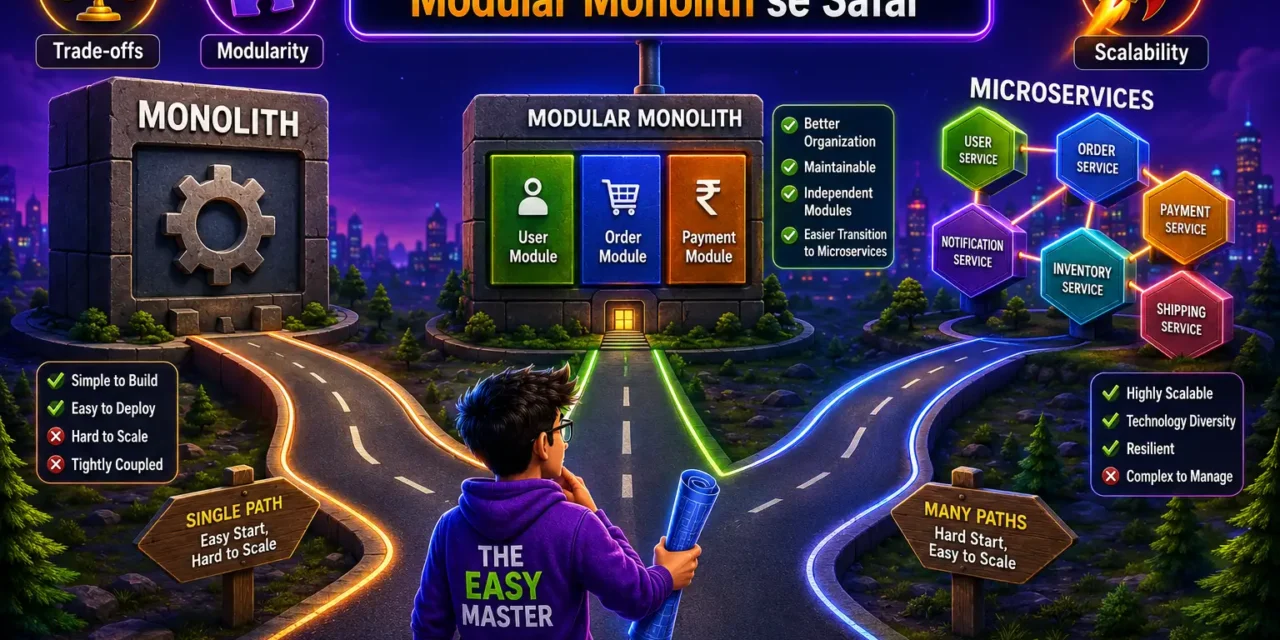
✅ Modular monolith – middle ground jo best of both worlds
✅ Comparison table – ek nज़र में difference
✅ Kab kya choose karein – decision framework
✅ Real-world examples – Netflix, Uber, Shopify
✅ Migration path – monolith → modular monolith → microservices
✅ Common mistakes aur best practices
Chaliye architecture styles aur modular monolith ka safar shuru karte hain! 🏗️🚀
1. Monolithic Architecture Kya Hai? – सबसे Traditional
Monolithic architecture mein entire application एक single deployable unit होता है – ek codebase, ek database, ek runtime process। Sab components (UI, business logic, data access) ek saath tightly coupled hote hain।
Structure diagram:
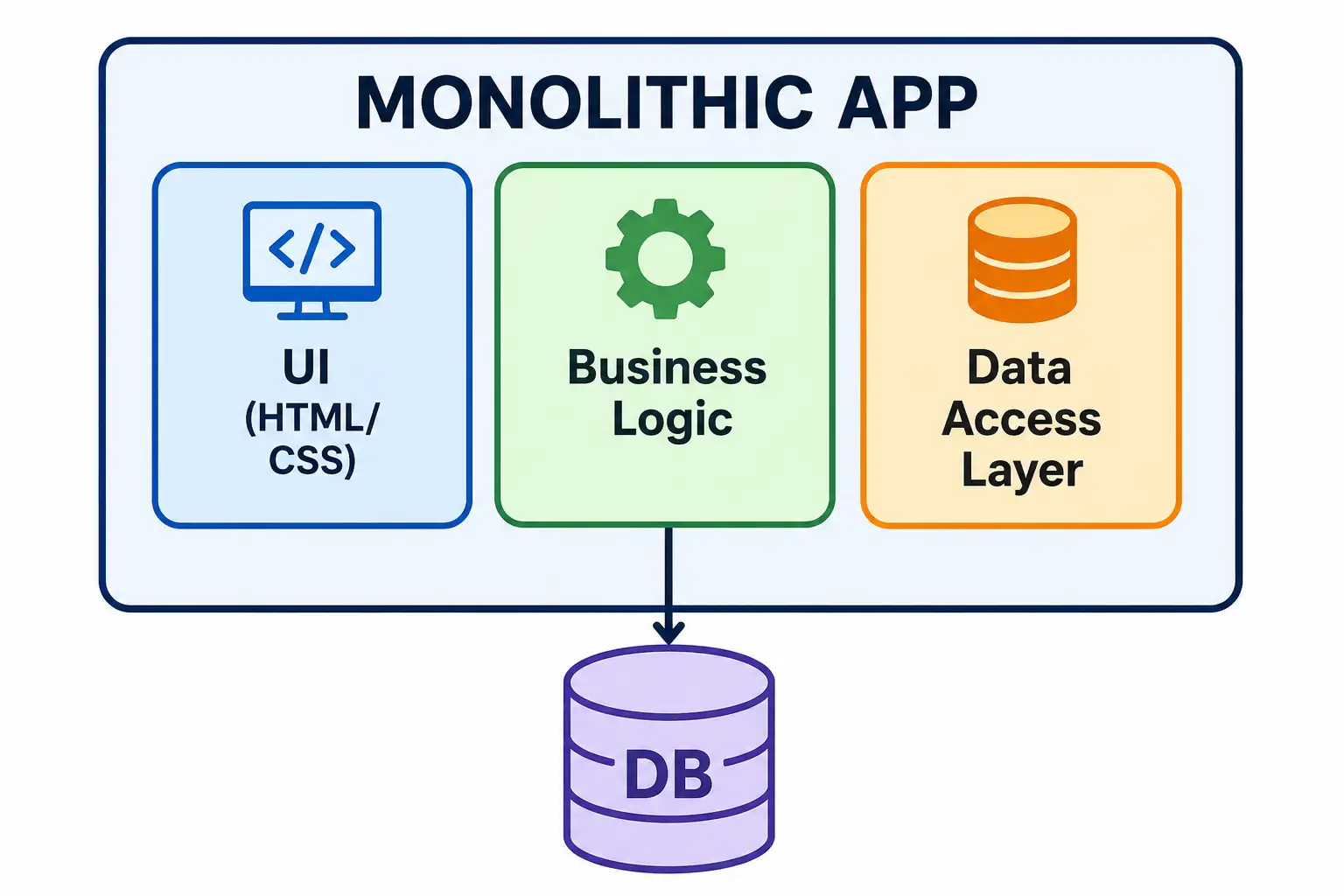
Examples: Traditional Laravel, Django, Ruby on Rails, Express.js (small apps), Spring Boot (single JAR)।
Simple analogy: Monolith ek पुराना दुकान है – sab kuch ek hi building में: billing, godown, customer service, packaging। Sab mila-जुला, lekin koi ek section band हुआ तो पूरी दुकान band।
2. Monolith ke Pros and Cons
Pros of Monolithic Architecture
| Benefit | Explanation |
|---|---|
| Simple development | Ek codebase – no inter-service communication complexity |
| Easy debugging | Single process, stack trace साफ – error track karna easy |
| Low latency | In-memory function calls – no network overhead |
| Atomic transactions | ACID transactions across entire app – easy data consistency |
| Simple deployment | One artifact (JAR, WAR, Docker image) – deploy ek command se |
| Less operational overhead | Ek server (or few) – monitoring, logging, scaling simple |
Cons of Monolithic Architecture
| Drawback | Explanation |
|---|---|
| Codebase becomes huge | Years mein millions of lines – IDE slow, onboarding takes months |
| Tight coupling | Ek module change करने से दूसरे break हो सकते हैं |
| Scaling inefficiency | Scale entire app even if only one module needs more resources |
| Slow deployment | Full app rebuild, test, deploy – even for small changes |
| High risk | Ek bug पूरी app को crash कर सकता है |
| Technology lock-in | Same tech stack throughout – cannot use polyglot |
| Team friction | Large team same codebase में conflicts, merge hell |
3. Microservices Architecture Kya Hai? – Modern Approach
Microservices architecture mein application multiple small, independent services में बंटी होती है। Har service apनी business capability handle karta है, अपना database rakhta है, और independently deploy hota है।
Structure diagram:
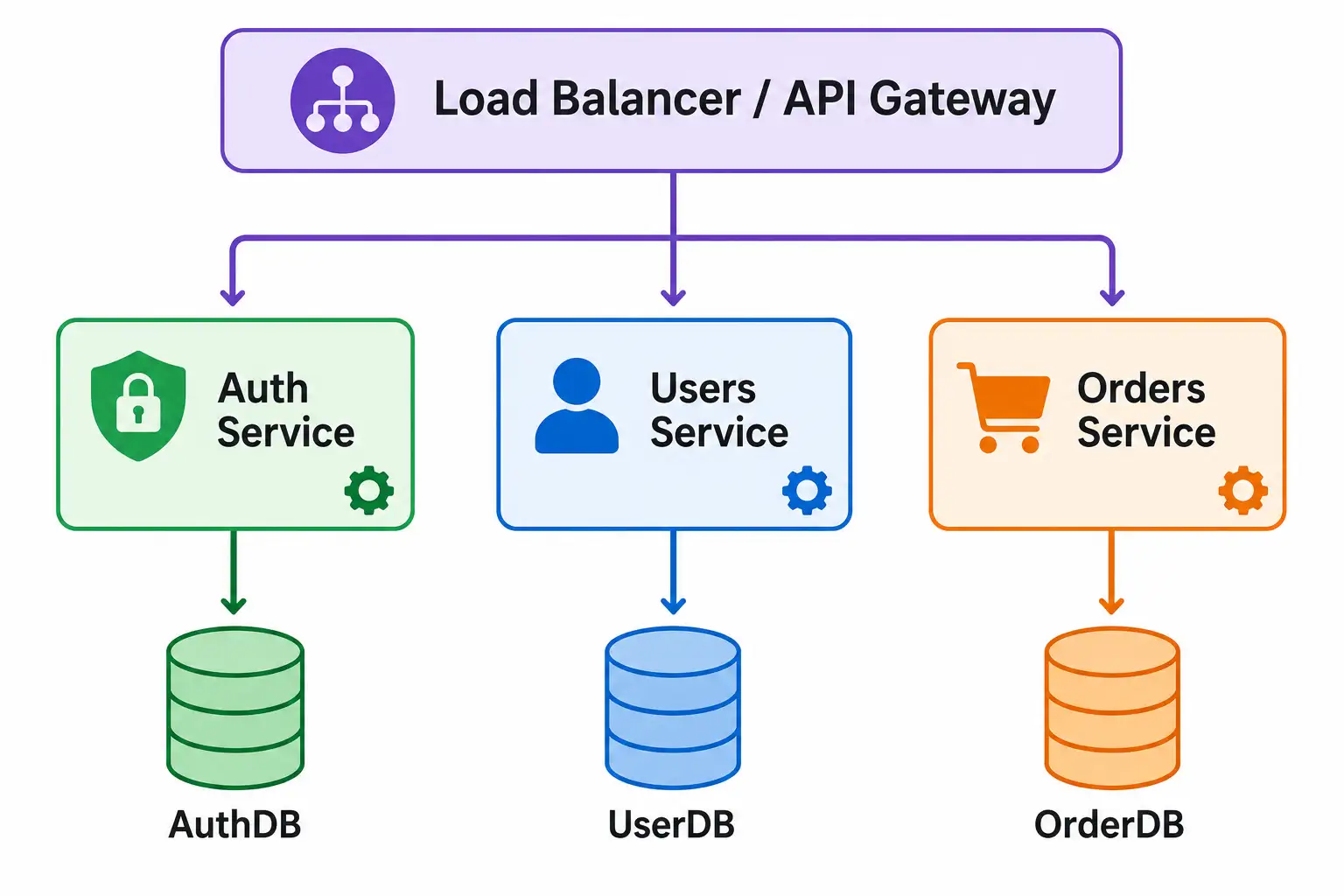
Examples: Netflix (hundreds of services), Uber, Amazon, Spotify।
Simple analogy: Microservices एक मॉल जैसा है – alag-alag shops (services) अपनी जगह, अपना stock (database), अपने workers। एक shop बंद हो तो mall band नहीं होता।
4. Microservices ke Pros and Cons
Pros of Microservices Architecture
| Benefit | Explanation |
|---|---|
| Independent scaling | Bas high traffic services scale karo – cost effective |
| Fault isolation | Ek service crash → baaki unaffected |
| Team autonomy | Different teams independent services par काम कर सकते हैं |
| Technology diversity | Har service अलग tech stack use kar sakti hai (Node.js, Python, Go) |
| Faster deployments | Sirf changed service deploy – downtime minimal |
| Easier to understand | Small codebase per service |
| Reusability | Service multiple apps use kar sakti hain |
Cons of Microservices Architecture
| Drawback | Explanation |
|---|---|
| Complexity | Distributed systems – service discovery, network latency, retries, circuit breakers |
| Data consistency | Cross-service transactions difficult (saga pattern, eventual consistency) |
| Debugging hell | Request multiple services se होकर गुजरती है – tracing mushkil |
| Operational overhead | Many services → many deployments, logs, metrics, alerts |
| Network latency | Inter-service calls network par – slower than in-memory |
| Testing complexity | Integration tests hard – mock many services |
| Data duplication | Denormalization often needed – duplication across services |
5. Modular Monolith – Best of Both Worlds
Modular monolith एक monolithic codebase hai, lekin modules are loosely coupled and well-encapsulated. Modules independent deploy nahi होते, but logical boundaries strongly defined hote hain।
Key characteristics:
- Ek hi codebase, ek hi deployment unit (one JAR/Docker image)
- Modules separate packages/namespaces में (e.g.,
com.myapp.users,com.myapp.orders) - Modules internally function calls use करते हैं (no network)
- Modules ke अपने-अपने database schemas हो सकते हैं (but same DB instance)
- Future mein module को microservice में extract करना आसान
Structure diagram:
┌────────────────────────────────────────────────┐
│              MODULAR MONOLITH                  │
│  ┌────────────┐  ┌────────────┐  ┌──────────┐  │
│  │  Users     │  │  Orders    │  │ Payments │  │
│  │  Module    │◄─┤  Module    │─►│ Module   │  │
│  │(own schema)│  │(own schema)│  │(own sch.)│  │
│  └────────────┘  └────────────┘  └──────────┘  │
│         │               │              │       │
│         ▼               ▼              ▼       │
│  ┌──────────────────────────────────────┐      │
│  │        Shared Database Instance      │      │
│  │  (but separate schemas / tables)     │      │
│  └──────────────────────────────────────┘      │
└────────────────────────────────────────────────┘
Modular Monolith ke fayde:
| Benefit | Explanation |
|---|---|
| No network overhead | Fast in-process calls |
| Single deployment | Simple CI/CD – deploy one artifact |
| Easy transactions | Cross-module ACID possible (within same DB) |
| Clear boundaries | Modules well-defined – easy to understand |
| Path to microservices | Future mein module को microservice बनाना easy |
| Team structure aligned | Each team owns a module |
Example: Shopify initially monolith tha, but well-modularized। Phir jab need hui, kuch modules (payment, recommendations) microservices mein extract kiye。
6. Microservices vs Monolith vs Modular Monolith – Comparison Table
| Aspect | Monolith | Modular Monolith | Microservices |
|---|---|---|---|
| Deployment | Single unit | Single unit | Independent per service |
| Scalability | Full app only | Full app only | Per service |
| Inter-module comm | In-memory calls | In-memory calls | Network (HTTP/gRPC) |
| Data consistency | Easy (ACID) | Easy (ACID) | Hard (eventual, saga) |
| Performance | Fast | Fast | Slower (network overhead) |
| Development speed | Initially fast, later slows | Consistent medium | Initially slow, later fast |
| Team dependency | High merge conflicts | Low (if modules bounded) | Very low |
| Technology freedom | Low | Low (same stack) | High (polyglot) |
| Complexity | Low | Medium | High |
| Best for | Small apps, startups | Medium-large apps | Very large apps, multiple teams |
7. Kab Monolith Use करे, Kab Microservices? – Decision Matrix
Start with modular monolith unless you have clear reason to go microservices from day one।
Choose Monolithic (or Modular Monolith) when:
| Situation | Why |
|---|---|
| Early-stage startup | Pivot quickly, simple infrastructure |
| Small team (<10 developers) | Coordination overhead less |
| No clear bounded contexts | Domain not well understood |
| Time to market critical | Monolith faster to build |
| Simple CRUD app | No need distributed |
Choose Microservices when:
| Situation | Why |
|---|---|
| Large team ( >50 developers) | Independent teams |
| Multiple bounded contexts clear | Well-known domain (e.g., e-commerce: user, product, order, payment) |
| Need independent scaling of services | Different services have different load |
| High fault tolerance required | One service failure shouldn’t kill all |
| Polyglot persistence / programming | Different tools for different jobs |
💡 Personal Experience: Maine ek microservices project start kiya early stage में – before understanding domain boundaries। 3 महीने में हम network latency, distributed transactions, service discovery जैसी problems mein फंस गए। Phir humne modular monolith पर shift kiya – fast delivery शुरू हुई। 2 saal baad, jab team बड़ी हुई और bounded contexts clear थे, tab humne carefully kuch services extract कीं। एक सबक – “Don’t start with microservices unless you’ve lived the pain of a monolith first।”
8. Real-World Examples – Netflix, Uber, Shopify
Netflix – Microservices pioneer
- Monolith से microservices में shift किया because scaling and rapid deployment needed
- Hundreds of services, each owned by independent team
- Key enablers: API gateway, circuit breakers (Hystrix), chaos engineering
Uber – Monolith to microservices
- Initially monolithic API, struggled with scaling
- Moved to microservices after hyper-growth
- Domain-based decomposition: trip, payment, rider, driver services
Shopify – Modular monolith advocate
- Shopify remains modular monolith (but massive scale – millions of requests per second)
- Well-modularized codebase with clear module boundaries
- Only a few functions extracted to microservices where necessary
Key takeaway: Not every company needs microservices। Shopify proves modular monolith can scale immensely if designed well।
9. Migration Path – Monolith se Microservices Tak (Modular Monolith se Safar)
Phase 0: Big Ball of Mud (pure monolith)
- No modular boundaries – everything coupled
- Painful changes, slow deployment
Phase 1: Introduce modularity (modular monolith)
- Refactor into modules:
user,order,inventory - Define clear APIs between modules (using interfaces, not directly accessing DB tables of other modules)
- Use same database but separate schemas
Phase 2: Extract read models / reporting queries
- Move heavy read queries (e.g., analytics) to separate read replicas or service
Phase 3: Extract a module as microservice
- Pick low-hanging fruit: e.g., email sending service, recommendation engine
- Communicate via sync (HTTP/gRPC) or async (message queue)
Phase 4: Incrementally extract others
- Gradual extraction over months
- API gateway to route between monolith and services
Phase 5: Fully distributed (if needed)
- Eventually most modules become services
- But some companies stay at modular monolith phase indefinitely
Important: Never do “big bang rewrite” – incremental extraction is safer।
10. Common Mistakes (aur Unka Solution!)
| Mistake | Why it’s wrong | Solution |
|---|---|---|
| Starting with microservices for a startup | Premature complexity, slow iteration | Start with modular monolith |
| Sharing database across microservices | Creates coupling – defeats purpose | Each service its own database |
| Microservice too small | (“nano-service”) | Extra network overhead, no real benefit |
| No proper bounded contexts | Constant changes across service boundaries | Define domains using Domain-Driven Design |
| Sync communication for everything | Service becomes tightly coupled | Use async message queue where appropriate |
| Not handling distributed transactions | Data inconsistency | Saga pattern, compensating transactions |
| Ignoring monitoring and tracing | Debugging distributed systems impossible | Use OpenTelemetry, Jaeger, Prometheus |
| Big bang migration | High risk, long downtime | Incremental strangler pattern |
11. Best Practices – Production-Level Tips
✅ Start with modular monolith – Clear module boundaries make future extraction easier।
✅ Use Domain-Driven Design (DDD) – Identify bounded contexts before splitting services।
✅ Database per service – Services should not share database schemas (except reporting)。
✅ Use API gateway – Single entry point for clients, hides internal service structure।
✅ Implement circuit breakers – Prevent cascading failures (Hystrix, Resilience4j)。
✅ Adopt distributed tracing – Jaeger, Zipkin to trace requests across services।
✅ Use asynchronous communication where possible – Message queues (Kafka, RabbitMQ) decouple services।
✅ Design for eventual consistency – Don’t expect cross-service ACID transactions。
✅ Automate everything – CI/CD, infrastructure as code, container orchestration (Kubernetes)。
✅ Monitor service health – Metrics, logs, alerts per service।
💡 Remember: Martin Fowler’s advice – “Microservices are not a silver bullet। First, learn to build a well-structured modular monolith.”
12. Resources – Cheat Sheet & Practice Prompts
Architecture Decision Cheat Sheet
| Question | Lean towards |
|---|---|
| Team size < 15 | Modular monolith |
| High need for independent deployment | Microservices |
| Startup, product-market fit unknown | Monolith / modular |
| Known domain, well-defined modules | Microservices |
| Need for polyglot persistence | Microservices |
| Simple CRUD, low traffic | Monolith |
Signs You Need Microservices
- Deployment takes hours because of codebase size
- One team’s change breaks another team’s feature
- Different parts need different scaling (e.g., video encoding vs auth)
- You’re already maintaining “distributed monolith” (accidental microservices)
Practice Prompts
Beginner:
- Simple e-commerce monolith design karo (Node.js Express) – modules: products, cart, orders।
servicepattern use karo – modules separate folders, but same database। Test that adding product works and order creation calls product module.
Intermediate:
- Above modular monolith से ‘product’ module को microservice में extract karo (separate Docker container)। API gateway (NGINX) setup karo that routes
/products/*to new service, rest to monolith।
Advanced:
- Event-driven communication implement karo between services using RabbitMQ। Example: Order service publishes
order_createdevent; Inventory service consumes and reduces stock। Use saga pattern for distributed transaction (compensating actions)。
13. FAQ
Q1: Microservices aur modular monolith mein main difference kya hai?
Deployment aur communication: Modular monolith ek hi deployable unit hai, modules in-process calls use karte hain। Microservices independently deploy hoti hain, network calls use karte hain।
Q2: Kya modular monolith scaling issues create karta hai?
Modular monolith full app scale karta hai – agar ek module high traffic hai, toh full app scale karna padega। Microservices mein sirf required service scale hoti hai। But most companies don’t need microservices level scaling initially।
Q3: Microservices mein database consistency kaise achieve karein?
Strong consistency possible nahi। Use saga pattern (choreography or orchestration) with compensating transactions। Design for eventual consistency।
Q4: Kya hum microservices aur monolith mix kar sakte hain?
Haan – Strangler pattern use karo। New features microservices mein, old monolith gradually replace।
Q5: Microservices ke liye team size kya honi chahiye?
Typically per service one “two-pizza team” (6-12 people)। If team small, microservices overhead may not be worth it।
Q6: Modular monolith se microservices mein migrate kaise karein?
Pehle monolith को modules में बांटो। Fir ek module ko pick करो – extract as separate service। Use API gateway to route। Repeat gradually। Don’t do big bang rewrite।
14. Conclusion – Ab Aapki Baari!
Bahut badhiya! Aapne aaj seekh liya:
✅ Microservices vs monolith Hindi – complete comparison
✅ Monolithic architecture – simple, fast, but scales poorly
✅ Microservices – flexible, independent, but complex
✅ Modular monolith – middle ground, best of both worlds
✅ Comparison table – decision kab kya choose karein
✅ Real-world examples – Netflix (microservices), Shopify (modular monolith)
✅ Migration path – monolith → modular → microservices
✅ Common mistakes – premature microservices, shared DB, no tracing
✅ Best practices – DDD, API gateway, saga, monitoring
Architecture decision is context-dependent। Start with modular monolith, move to microservices only when pain justifies complexity।
Aapki challenge: Apne current project (or a fictional project) ke liye architecture decide करो – monolith, modular monolith, or microservices। Justify your decision with pros/cons। Share in comments!
Next topic kya chahiye?
- Domain-Driven Design (DDD) – Bounded Contexts?
- API Gateway (Kong, NGINX, Traefik)?
- Service Mesh (Istio, Linkerd) – Kya Zaroori Hai?
Comment mein batao!
The Easy Master ke saath architecture decisions seekhte raho। Happy architecting! 🏗️🚀
Resource
- Martin Fowler – Monolith vs Microservices
- Modular Monolith – A Practical Guide (2024)
- Shopify’s Modular Monolith (Engineering Blog)
- Uber’s Microservices Migration Story
- Domain-Driven Design (DDD) – Eric Evans
Additional Resources
- Next.js App Router – Pages Router से क्या बदला? Complete Guide 2026
- Next.js Server Components – ‘use client’ कब और कहां Use करें
- Next.js Routing – Layouts, Dynamic Routes and Nested Routes 2026
- Next.js 16 New Features – Turbopack, Cache Components and proxy.ts
- Next.js Partial Prerendering – Static and Dynamic Content साथ में
- Next.js Authentication – JWT Session Management (App Router) 2026
- Next.js SEO – Metadata API and Image Optimization समझे 2026
- Next.js TypeScript – Full-Stack Type-Safe App कैसे बनाएं
- FastAPI Kya Hai? FastAPI Python Setup Aur Pehla API Hindi 2026
- FastAPI Path Parameters Hindi – शून्य से हीरो तक गाइड 2026
- Pydantic v2 Tutorial Hindi – Data Validation Master 2026
- FastAPI dependency injection Hindi – Code Reuse Ka Magic
- FastAPI Async Await Hindi – Non-Blocking Code 2026
- FastAPI PostgreSQL SQLModel Hindi – Async Guide 2026
- FastAPI JWT Authentication Hindi – Secure API Login
- FastAPI OpenAI Integration Hindi – AI Chatbot API 2026
- FastAPI Multi-Agent AI Hindi – LangGraph Zero to Hero
- FastAPI Deployment Hindi – Railway Zero to Hero 2026
- Docker Introduction in Hindi? Containers vs Virtual Machines
- Docker Images and Containers Hindi – Pehla Container
- Docker Compose Tutorial Hindi – Node.js + MongoDB
- Docker Volumes Networking Hindi – Data Persist कैसे करें
- Kubernetes Architecture Hindi – Pods, Nodes, Cluster
- Minikube Tutorial Hindi – Local Cluster कैसे बनाए
- Kubernetes Deployments Services Hindi – App Expose Karein
- K8s Ingress Tutorial Hindi – Domain se App Access
- Helm Kya Hai? – Kubernetes Charts Se App Deploy
- GraphQL Introduction in Hindi – REST vs GraphQL Comparison
- GraphQL Schema Tutorial Hindi – Types Queries Resolvers
- GraphQL Queries Mutations Hindi – Frontend Integration
- GraphQL Advanced Features Hindi – Fragments Aliases Variables
- Apollo Server GraphQL Node.js TypeScript Hindi – API Kaise Banaye
- Apollo Client React Hindi – GraphQL Queries Use Kaise Karein
- GraphQL Testing Supertest Hindi – Queries Mutations Test
- Integration Testing Node.js – Mock DB aur APIs Hindi
- E2E Testing Playwright – GraphQL Frontend Testing & CI/CD Hindi
- System Design Kya Hai? System Design Introduction in Hindi
- Vertical Horizontal Scaling Hindi – कब क्या Use करें
- Load Balancing Tutorial Hindi: Round Robin and Hashing
- Database Scaling Sharding Hindi – Read Replicas and Sharding
Views: 286