
नमस्ते दोस्तों!
स्वागत है The Easy Master पर!
आपने message queues, event-driven architecture seekh liya। अब एक aur important performance tool – Caching। Kya aapki API slow ho rahi hai? Database queries time ले रही हैं? Same data baar-baar fetch ho raha hai?
Yahi problem caching solve karta hai – frequently accessed data को fast storage (RAM) mein store karo, takki next requests fast ho।
Jab maine pehli baar caching implement ki, toh pahle query 200ms लेती थी, cache hit hone ke baad 5ms। Performance 40x better! User experience instantly improve hua। Caching magic hai – but सही strategy चुनना जरूरी है।
इस Caching strategies Hindi article mein main aapko sikhata hoon:
✅ Caching kya hai – types, why cache, trade-offs
✅ Application caching (in-memory) – Node.js, Python example
✅ Distributed caching – Redis, Memcached, why needed
✅ CDN caching – CloudFront, Cloudflare, edge caching
✅ Caching strategies – Cache-aside, Read-through, Write-through, Write-behind
✅ Eviction policies – LRU, LFU, TTL, FIFO
✅ Cache invalidation – The hardest problem in CS
✅ Redis vs Memcached – comparison, use cases
✅ Real-world examples – Twitter, Instagram, e-commerce
✅ Common mistakes aur best practices
Chaliye caching ki duniya mein step rakhte hain! 🚀⚡
Table of Contents
1. Caching Kya Hai? – Performance Ka Magic Wand
Caching ek technique hai jisme frequently accessed data को temporary storage (cache) mein rakha जाता है – fast storage (usually RAM) – ताकि future requests fast serve ho सकें।
Simple analogy:
Library की popular books को reference section mein रखना – बार-बार store room (disk/database) जाने की जरूरत नहीं।
Caching layers (user request se database tak):
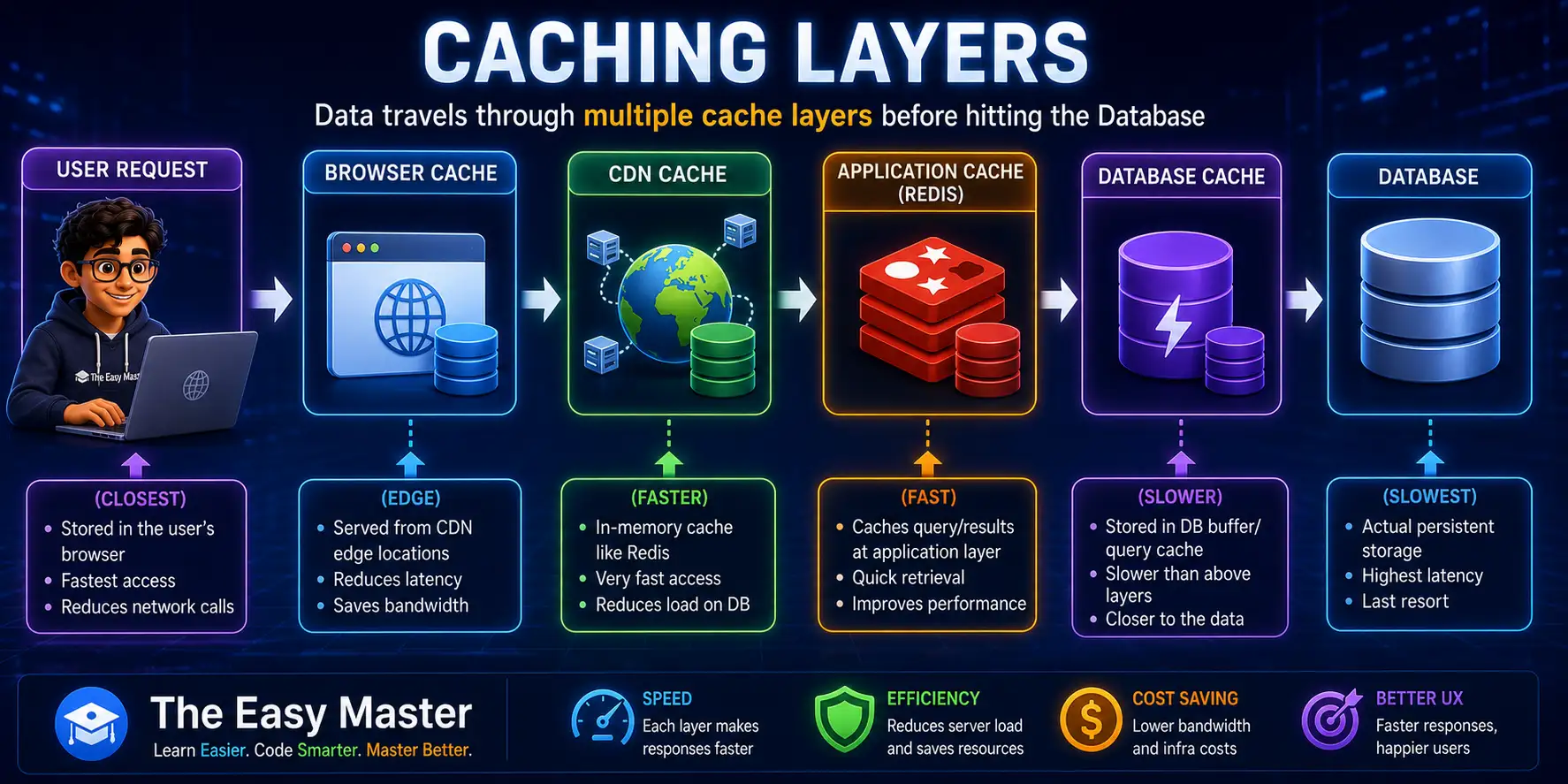
Personal Experience: Maine ek e-commerce API mein product details database से fetch kar रहा था – 500ms lagta था। Redis में cache kiya, response time 15ms हो गया। User satisfaction बढ़ा और database load 80% कम हुआ।
2. Why Cache? – Benefits and Trade-offs
Benefits of caching:
| Benefit | Explanation |
|---|---|
| Lower latency | RAM से data retrieval disk या network से 10-100x fast |
| Reduced database load | Cache hit → DB query avoid |
| Cost savings | Less DB read operations → smaller DB instance possible |
| Handle traffic spikes | Cache absorbs peak load |
| Improved scalability | Reads scale with cache (horizontal) |
Trade-offs / Challenges:
| Challenge | Explanation |
|---|---|
| Stale data | Cached data outdated हो सकता है |
| Cache invalidation | Jab data change ho, cache update करना complex |
| Memory cost | RAM expensive than disk |
| Complexity | Cache invalidation, eviction policies, consistency |
| Cold start | Cache empty hone पर many DB hits |
Famous quote: “There are only two hard things in Computer Science: cache invalidation and naming things.” – Phil Karlton
3. Types of Caching – Browser, CDN, Application, Database
| Cache Type | Location | Use case | Example |
|---|---|---|---|
| Browser cache | Client browser | Static assets (HTML, CSS, JS, images) | HTTP cache-control headers |
| CDN cache | Edge servers (geographically distributed) | Static files, API responses (GET) | CloudFront, Cloudflare |
| DNS cache | ISP, OS, browser | Domain to IP mapping | dig TTL |
| Reverse proxy cache | Server side (before app) | HTTP response caching | Varnish, NGINX proxy cache |
| Application cache (in-memory) | App process memory | Session data, computed results | Python dictionary, JS Map |
| Distributed cache | Dedicated cache servers (Redis, Memcached) | Shared across app instances | Session store, rate limiting |
| Database cache | Inside DB (buffer pool) | Query results, index pages | PostgreSQL shared buffers |
Focus of this article: Application cache (in-memory & distributed) and CDN caching.
4. Application Cache – In-Memory aur Distributed
4.1 In-Memory Cache (Single Node)
Cache stored within the application process (memory). Good for: single instance apps, local session data.
Node.js example (Map):
const userCache = new Map();

function getUser(id) {
    if (userCache.has(id)) {
        console.log('Cache hit');
        return userCache.get(id);
    }
    const user = db.query('SELECT * FROM users WHERE id = ?', id);
    userCache.set(id, user);
    return user;
}
Python example (dictionary):
user_cache = {}

def get_user(user_id):
    if user_id in user_cache:
        print("Cache hit")
        return user_cache[user_id]
    user = db.query(f"SELECT * FROM users WHERE id = {user_id}")
    user_cache[user_id] = user
    return user
Limitations:
- Cache not shared across multiple instances
- Memory limited to app memory
- Data lost on app restart
4.2 Distributed Cache (Shared)
Separate cache server (like Redis) shared across all app instances। Good for: multi-instance deployments, microservices, persistent session store.
Why distributed cache? When you have multiple app instances (horizontal scaling), each instance has its own memory – cache misses high। Distributed cache provides a single shared cache layer।
Popular distributed caches: Redis (most popular), Memcached, Hazelcast, Apache Ignite.
5. Distributed Caching – Redis, Memcached
5.1 Redis – Data Structure Store
Redis (REmote DIctionary Server) ek in-memory data structure store hai। Supports strings, hashes, lists, sets, sorted sets, bitmaps, hyperloglogs, geospatial indexes।
Why Redis popular?
- Data structures – beyond simple key-value
- Persistence – snapshot to disk, restart पर data recover
- Replication – master-slave for HA
- Atomic operations – INCR, LPUSH, SADD
- Pub/Sub – lightweight messaging
- Lua scripting – complex operations server-side
Common Redis use cases:
- Session store
- Leaderboards (sorted sets)
- Rate limiting (INCR with TTL)
- Caching database queries (cache-aside)
- Real-time analytics
- Job queues (list)
- Distributed locks (Redlock)
5.2 Memcached – Simple Key-Value
Memcached simple, high-performance distributed memory caching system। Key-value only, no persistence, no replication (client handles distribution).
Memcached pros:
- Simpler, easier to scale (client-side sharding)
- Multi-threaded, very fast
- Lower memory overhead (for pure key-value)
Memcached cons:
- No persistence – cache loss on restart
- No data structures
- No authentication (older versions)
Recommendation: For most modern apps, Redis is better due to features and persistence। Use Memcached only if you need pure key-value with very high throughput and don’t need persistence/data structures.
6. CDN Caching – Content Delivery Network
CDN (Content Delivery Network) geographically distributed servers that cache static and dynamic content closer to users।
How CDN works:
- User requests
https://example.com/image.png - DNS points to CDN edge server (closest to user)
- If cache hit → serve instantly
- If cache miss → fetch from origin (your server), cache, then serve
What to cache on CDN:
- Static assets: images, CSS, JS, fonts, videos
- API responses (GET) – with appropriate cache-control headers
- HTML pages (for static sites)
Popular CDNs:
- AWS CloudFront (integrated with S3, EC2)
- Cloudflare (free tier available)
- Fastly (purge API, real-time logging)
- Akamai (enterprise)
Cache headers control:
Cache-Control: max-age=3600, public
Cache-Control: no-cache
Cache-Control: private, max-age=60
Pro Tip: For dynamic APIs, use CDN with short TTL (e.g., 10-60 seconds) for frequently read data (news feed, scores, weather).
7. Caching Strategies – Cache-Aside, Read-Through, Write-Through, Write-Behind
| Strategy | How it works | Best for | Pros | Cons |
|---|---|---|---|---|
| Cache-Aside (Lazy) | App checks cache first; on miss, reads DB, writes cache | Most read-heavy apps | Simple, only requested data cached | Cache miss latency, stale data possible |
| Read-Through | Cache sits between app & DB; cache fetches data from DB on miss | Similar to cache-aside but abstraction | App code simpler | Same as cache-aside |
| Write-Through | Write to cache and DB together (sync) | Consistency-critical apps | Strong consistency | Higher write latency |
| Write-Behind (Write-Back) | Write to cache first, async write to DB | High write throughput apps | Low write latency | Data loss risk if cache crashes before flush |
7.1 Cache-Aside (Lazy Loading) – Most Common
async function getUser(userId) {
    // 1. Check cache
    let user = await redis.get(`user:${userId}`);
    if (user) return JSON.parse(user);

    // 2. Cache miss – fetch from DB
    user = await db.query('SELECT * FROM users WHERE id = ?', userId);

    // 3. Store in cache (with TTL)
    await redis.set(`user:${userId}`, JSON.stringify(user), 'EX', 3600);
    return user;
}
7.2 Write-Through
async function updateUser(userId, data) {
    // 1. Update database
    await db.query('UPDATE users SET ... WHERE id = ?', userId, data);

    // 2. Update cache (or delete)
    await redis.set(`user:${userId}`, JSON.stringify(data), 'EX', 3600);
}
7.3 Write-Behind (Write-Back)
async function updateUser(userId, data) {
    // Write to cache immediately
    await redis.set(`user:${userId}`, JSON.stringify(data));

    // Queue write to database async
    await queue.add('update-user-db', { userId, data });
}
8. Cache Eviction Policies – LRU, LFU, TTL, FIFO
When cache reaches max memory, old entries need to be removed (evicted).
| Policy | How it works | Use case |
|---|---|---|
| LRU (Least Recently Used) | Discard least recently accessed items | General-purpose, good for temporal locality |
| LFU (Least Frequently Used) | Discard least frequently accessed items | Access patterns with popularity skew |
| TTL (Time To Live) | Expire after fixed duration | Time-sensitive data (news, sessions) |
| FIFO (First In First Out) | Evict oldest cached item (by insertion time) | Simple, but less efficient |
| Random | Randomly evict | Very simple, okay for some cases |
Redis maxmemory policies:
noeviction– return error on maxmemoryallkeys-lru– evict LRU from all keysvolatile-lru– evict LRU among keys with TTLallkeys-random– random evictionvolatile-random– random among keys with TTLvolatile-ttl– evict keys with shorter TTL first
Recommendation: Use
allkeys-lruwithmaxmemoryand set TTL on keys where freshness matters (volatile-lru).
9. Redis vs Memcached – Kaunsa Choose Karein?
| Aspect | Redis | Memcached |
|---|---|---|
| Data structures | Strings, hashes, lists, sets, sorted sets, streams | Key-value only |
| Persistence | Yes (RDB snapshots, AOF log) | No |
| Replication | Master-slave, Sentinel, Cluster | No (client-side sharding) |
| Atomic operations | Yes (INCR, LPUSH, SADD) | Yes (INCR, but limited) |
| Lua scripting | Yes | No |
| Multi-threaded | Single-threaded (v6+ has I/O threads) | Yes (multi-threaded) |
| Max key size | 512 MB | 250 bytes (default) |
| Max value size | 512 MB | 1 MB (adjustable) |
| Use cases | Caching, real-time analytics, sessions, leaderboards, queues, locks | Pure caching (key-value, high throughput) |
Recommendation: Use Redis for almost all use cases due to features, persistence, and active development. Use Memcached only if you need extreme key-value throughput and can’t use Redis.
Redis Cluster provides automatic sharding, high availability, and horizontal scaling (supports up to 1000 nodes). Redis 7.x+ has improved performance and reliability. In 2026, Redis is the de facto standard for distributed caching.
10. Cache Invalidation – The Hardest Problem
Cache invalidation is the process of updating or removing cached data when the underlying data changes.
Why hard? Because you may not know all places where data is cached (different caches, different keys, different patterns).
Strategies for cache invalidation:
| Strategy | How it works | Pros | Cons |
|---|---|---|---|
| TTL (Time to Live) | Data expires after fixed time | Simple, no coordination | Stale data until expiry |
| Write-through | Update cache on every write | Strong consistency | Slower writes, cache may have unused data |
| Write-invalidate | Delete cache entry on write | Avoids stale data | Next read will be cache miss (DB hit) |
| Pattern-based invalidation | Delete by key pattern (e.g., user:*) | Efficient | Requires knowing patterns |
| Event-driven invalidation | Service publishes “data changed” event, caches listen and purge | Decoupled | Complexity |
Practical tip: Use TTL as default, plus explicit invalidation for critical data.
// Invalidation example
async function updateUser(userId, data) {
    await db.update(userId, data);
    // Delete cache entry so next read fetches fresh
    await redis.del(`user:${userId}`);
    // Or update cache with new data (write-through)
}
11. Real-World Examples – Twitter, Instagram, E-commerce
Example 1: Twitter – Feed Caching
- User timeline – precomputed and cached in Redis (sorted sets)
- Tweet cache – each tweet object stored in Redis with TTL
- Home timeline – generated from cache + recent writes
- Eviction: LRU with TTL for trending tweets
Example 2: Instagram – User Profiles & Media
- User profile – cached in Memcached (originally, now migrating to Redis)
- Feed – precomputed timeline using Redis sorted sets
- Media metadata – CDN for images/videos (CloudFront)
- Eviction: TTL for profile data (few minutes), LRU for feed
Example 3: E-commerce – Product Details
- Product catalog – Redis cache-aside (TTL 1 hour)
- Inventory – cached with short TTL (10 seconds) or write-through
- CDN – product images, static assets
- Cache invalidation – on product update, delete product cache key; also purge CDN cache path
12. Common Mistakes (aur Unka Solution!)
| Mistake | Why it’s wrong | Solution |
|---|---|---|
| Caching everything | Wastes memory, evicts useful data | Cache only frequently accessed, expensive-to-compute data |
| No TTL | Stale data lives forever | Always set TTL unless cache is exact replica (e.g., session) |
| Using cache as primary database | Data loss risk, no query capability | Cache is ephemeral; always persist to DB |
| Cache stampede (thundering herd) | Cache miss triggers many simultaneous DB queries | Use SETNX for single producer, or request coalescing |
| No monitoring | Cache hit ratio unknown, issues unnoticed | Monitor hit ratio, memory usage, eviction count |
| Large cache keys | Wastes memory, slow | Use short keys, avoid serializing huge objects |
| Local cache for multi-instance apps | High cache misses, inconsistency | Use distributed cache (Redis) |
| Ignoring cache warmup | Cold start floods DB | Warm cache on deployment (preload popular data) |
| No error handling for cache failures | Cache down → app fails | Fallback to DB |
| Misconfigured eviction policy | Hot data evicted | Choose LRU or LFU based on access pattern |
13. Best Practices – Production-Level Tips
✅ Cache only what matters – Profile data, product details, API responses (GET). Don’t cache user-specific personalized data unless necessary.
✅ Set appropriate TTL – Balance freshness vs performance. News: 1-5 mins, product catalog: 1 hour, session: hours/days.
✅ Use cache-aside (lazy loading) as default – Simple, only requested data cached.
✅ Add explicit invalidation for write-heavy data – On update, delete cache key (write-invalidate) or update (write-through).
✅ Use connection pooling for Redis – Reuse connections, avoid overhead.
✅ Monitor cache metrics – Hit rate, miss rate, memory usage, evicted keys. Alert if hit rate drops.
✅ Implement cache warmup on deployment – Preload popular keys to avoid cold start spikes.
✅ Handle cache failures gracefully – If Redis unreachable, fallback to database (but log alert).
✅ Use key naming convention – {service}:{entity}:{id} (e.g., catalog:product:123). Use prefix for easy invalidation.
✅ Avoid large values (>1MB) – Redis performs poorly; store pointers and fetch from object storage.
✅ Use Redis Pipelines for batch operations – Reduce round trips.
✅ Secure Redis – Set password, bind to private network, use TLS.
Personal Experience: One time we had a Redis server with no eviction policy and no TTL on keys. Memory filled up, Redis crashed, and all instances lost cache. Now we always set
maxmemory-policy allkeys-lruand TTL on all keys. Also we added monitoring to alert when memory >80%.
14. Resources – Cheat Sheet & Practice Prompts
Redis Commands Cheat Sheet
| Task | Command |
|---|---|
| Set string | SET user:123 '{"name":"Rahul"}' EX 3600 |
| Get string | GET user:123 |
| Delete key | DEL user:123 |
| Increment counter | INCR page_views:home |
| Add to set | SADD tags:product:123 "electronics" |
| Get set members | SMEMBERS tags:product:123 |
| Add to sorted set (leaderboard) | ZADD leaderboard 100 "user123" |
| Get top 10 | ZREVRANGE leaderboard 0 9 WITHSCORES |
| Set hash | HSET user:123 name "Rahul" email "r@e.com" |
| Get hash field | HGET user:123 name |
Cache Strategy Decision Matrix
| Read/write ratio | Consistency need | Recommended strategy |
|---|---|---|
| Mostly read (>90%) | Low (news, catalog) | Cache-aside + TTL |
| Read-write mix | Medium | Write-through or write-invalidate |
| Write-heavy | High (inventory) | No cache (or short TTL) |
| Low read | Any | Don’t cache |
Practice Prompts
Beginner:
- Node.js + Express app banayein जो Redis से product details fetch kare using cache-aside pattern। TTL set karein 60 seconds। Without Redis, test performance difference।
Intermediate:
- Rate limiter implement karein using Redis INCR with TTL। Allow 10 requests per minute per IP। If limit exceeded, return 429 status।
Advanced:
- Leaderboard system implement karein using Redis sorted sets (scores: points, member: user_id)। Support top 10, pagination, and real-time updates। Add Lua script for atomic score update and rank retrieval।
15. FAQ
Q1: Cache aside aur write-through mein kya antar hai?
Cache-aside: app checks cache, on miss reads DB, writes cache। Write-through: app writes to cache and DB together (synchronous), cache always up-to-date。
Q2: Redis aur Memcached mein main difference kya hai?
Redis supports data structures, persistence, replication; Memcached simple key-value, no persistence। Redis recommended for most use cases।
Q3: CDN caching kab use karein?
Static assets (images, CSS, JS) always। For API responses, use CDN only for public, cacheable GET endpoints (news, scores, product catalog) with short TTL。
Q4: Cache invalidation kyun hard hai?
Data changed होने पर पता करना mushkil hai ki कहाँ-कहाँ cached है (different keys, different caches, distributed systems)। Plus consistency vs performance trade-off।
Q5: TTL value kitni rakhein?
Depends on data freshness requirement: product catalog: 1-6 hours, news feed: 1-5 minutes, session: hours/days, user profile: 15-30 minutes।
Q6: Cache hit rate kitni honi chahiye?
Depends, but typically >80% is good। Monitor and adjust caching strategy, TTL, or eviction policy if hit rate low।
16. Conclusion – Ab Aapki Baari!
Bahut badhiya! Aapne aaj seekh liya:
✅ Caching strategies Hindi – complete guide with Redis, CDN, distributed caching
✅ Why cache – benefits, trade-offs, types
✅ Application cache – in-memory vs distributed
✅ Distributed caching – Redis, Memcached, comparison
✅ CDN caching – edge servers, headers, use cases
✅ Caching strategies – cache-aside, read-through, write-through, write-behind
✅ Eviction policies – LRU, LFU, TTL, FIFO
✅ Cache invalidation – hardest problem, strategies
✅ Real-world examples – Twitter, Instagram, e-commerce
✅ Best practices & common mistakes – TTL, monitoring, fallback
Caching performance improvement ka most effective tool hai। Redis aur CDN ke saath aap scalable, fast systems bana sakte ho।
Aapki challenge: Ek simple API implement karo (e.g., product catalog) with Redis cache-aside। Measure response time with and without cache। Then add CDN for static assets (e.g., using CloudFront)。 Share your results in comments!
Next topic kya chahiye?
- API Gateway (Kong, NGINX, Traefik)?
- Service Mesh (Istio, Linkerd)?
- Chaos Engineering – Resilience Testing?
Comment mein batao!
The Easy Master ke saath caching seekhte raho। Happy caching! 🚀⚡
Resources
- Redis Official Documentation
- Redis Eviction Policies
- Caching Strategies – AWS Architecture Blog
- CDN Caching Explained – Cloudflare
- Caching – System Design Primer
Additional Resources
- Next.js App Router – Pages Router से क्या बदला? Complete Guide 2026
- Next.js Server Components – ‘use client’ कब और कहां Use करें
- Next.js Routing – Layouts, Dynamic Routes and Nested Routes 2026
- Next.js 16 New Features – Turbopack, Cache Components and proxy.ts
- Next.js Partial Prerendering – Static and Dynamic Content साथ में
- Next.js Authentication – JWT Session Management (App Router) 2026
- Next.js SEO – Metadata API and Image Optimization समझे 2026
- Next.js TypeScript – Full-Stack Type-Safe App कैसे बनाएं
- FastAPI Kya Hai? FastAPI Python Setup Aur Pehla API Hindi 2026
- FastAPI Path Parameters Hindi – शून्य से हीरो तक गाइड 2026
- Pydantic v2 Tutorial Hindi – Data Validation Master 2026
- FastAPI dependency injection Hindi – Code Reuse Ka Magic
- FastAPI Async Await Hindi – Non-Blocking Code 2026
- FastAPI PostgreSQL SQLModel Hindi – Async Guide 2026
- FastAPI JWT Authentication Hindi – Secure API Login
- FastAPI OpenAI Integration Hindi – AI Chatbot API 2026
- FastAPI Multi-Agent AI Hindi – LangGraph Zero to Hero
- FastAPI Deployment Hindi – Railway Zero to Hero 2026
- Docker Introduction in Hindi? Containers vs Virtual Machines
- Docker Images and Containers Hindi – Pehla Container
- Docker Compose Tutorial Hindi – Node.js + MongoDB
- Docker Volumes Networking Hindi – Data Persist कैसे करें
- Kubernetes Architecture Hindi – Pods, Nodes, Cluster
- Minikube Tutorial Hindi – Local Cluster कैसे बनाए
- Kubernetes Deployments Services Hindi – App Expose Karein
- K8s Ingress Tutorial Hindi – Domain se App Access
- Helm Kya Hai? – Kubernetes Charts Se App Deploy
- GraphQL Introduction in Hindi – REST vs GraphQL Comparison
- GraphQL Schema Tutorial Hindi – Types Queries Resolvers
- GraphQL Queries Mutations Hindi – Frontend Integration
- GraphQL Advanced Features Hindi – Fragments Aliases Variables
- Apollo Server GraphQL Node.js TypeScript Hindi – API Kaise Banaye
- Apollo Client React Hindi – GraphQL Queries Use Kaise Karein
- GraphQL Testing Supertest Hindi – Queries Mutations Test
- Integration Testing Node.js – Mock DB aur APIs Hindi
- E2E Testing Playwright – GraphQL Frontend Testing & CI/CD Hindi
- System Design Kya Hai? System Design Introduction in Hindi
- Vertical Horizontal Scaling Hindi – कब क्या Use करें
- Load Balancing Tutorial Hindi: Round Robin and Hashing
- Microservices vs Monolith Hindi – Modular Monolith se Safar
Views: 352